Info

Kalamu ya Salaam's information blog

Archive for


cfp upenn

“April in Paris”:

African American Expatriate Writers


full name / name of organization: 
Midwest Modern Language Association

contact email: 
tiffanyuaustin@gmail.com or andre.johnson@asurams.edu.

African Literature
African American Literature
Co-chairs: Tiffany Austin, André S. Johnson

“April in Paris”: African American Expatriate Writers

Globalization has become the oft cited contemporary concept for engaging with our ever more intimate world through interconnectivity partly brought on by advances through internet technology. But what about the experiences of those black writers who were physically travelling abroad to experience the world before these resources became available Whether they emigrated for political, economic, artistic, or personal reasons, expatriation affected many black writers of note in subject matter and influence. Whether through forced or self-exile, from a sense of cosmopolitanism or artistic freedom, these writers, artists and intellectuals expanded the notions of blackness and left behind works that force us to investigate what it meant and means to enter a “new” home.

We request papers that deal with black writers’ relationship to old and new homes as part of their journey to foreign cities. Examining the pull of black writers to France’s “passion” for all art “black,” panels could focus on Langston Hughes, Claude McKay, Countee Cullen, James Baldwin, and Richard Wright. Other black expatriate writers who could be considered include Chester Himes, Frank Yerby, Nella Larsen, William Gardner Smith, and even more contemporary writers. Within panels, discussants may want to examine the themes of home, exile, abandonment, isolationism, community, identity politics, and migratory subject hood.

Email 250-300 word abstracts to tiffanyuaustin@gmail.com orandre.johnson@asurams.edu.


>via: http://call-for-papers.sas.upenn.edu/node/56896


Short Story Day Africa

Terra Incognita


Before every inch of the world had been explored, cartographers denoted uncharted territories as terra incognita. This year, Short Story Day Africa asks writers to look deep into their imaginations to draw out stories fantastical and mythical. Envision Africa in the future, or an alternative history to the ones we’ve been told and sold. Dragons in Diamey? Werewolves in Windhoek? Don’t be passé – think beyond what you already know about speculative fiction. Here be dragons. Here be lions. Step off those well-worn paths into terra incognita.

Short Story Day Africa wants your speculative fiction: horror, fantasy, dystopian, sci-fi, alternative history and magical realism all fit the bill.

Word count: 3000* – 5000 words. The long-listed stories selected by our panel of judges will be collected in an anthology and published individually on Worldreader Mobile to over half a million readers.

*Selected stories will be entered in The Caine Prize for African Fiction, hence the lower word limit.


Deadline: 30 June 2014
The shortlist will be announced in September 2014.
Winner announced in October 2014.
 

1st Prize: R2000 cash
(Sponsored by BooksLive)
10 Module Creative Writing Course from All About Writing worth R5000
The 2013 Caine Prize Anthology

2nd Prize: R1000 voucher to spend on African fiction at an indie bookshop of your choice
(Sponsored by Louis Greenberg)
The Character Course from All About Writing worth R1500
The 2013 Caine Prize Anthology

3rd Prize: R300 voucher to spend on  African fiction at an indie bookshop of your choice
(Sponsored by Paige Nick)
The Power of Writing Course from All About Writing worth R500
The 2013 Caine Prize Anthology

The longlist will receive a e-book of the anthology, and a work of African short fiction from
Modjaji Books.

Terms and Conditions Apply. Click here to read them.


>via: http://shortstorydayafrica.org/write-2014-2/terra-incognita/


DJ Rahdu

DJ RHADU

The Diamond Soul XXXperience 010 | 5/23/14

DJ Rahdu returns to lace you with 2 hours of Diamond Soul. Prepare for a carefully curated show containing only the best in soul, rare grooves, remixes and covers. Rahdu returns to the previous On Deck compilation with the Applejac produced Better by Nicolas Ryan Gant as well as featuring music from On Deck alumni: Tall Black Guy and Buscrates. Dilla gets props on this episode via remakes of SV’s Jealousy and PotatoHead People’s flip of a Jay Dee sample featuring his brother Illa J. Mounds of niceness this session!

Small Professor – Watermelon Spank
Jessica Renee – Commercialize
Illa J x PotatoHead People – Never Left
Mr President – Gimme All What You Got
Sade – Sweetest Taboo (Flava Dre Massage) (Warren Xclnce ReWork)
Rahsaan Patterson – So Right
Madlib – Cue 06
Yuna – Hold On We’re Going Home
Tiny Hearts – Stay (Jeedo X Remix)
Tall Black Guy – One to One
Nicholas Ryan Gant- Better (prod by Applejac)
Common – I Used To Love H.E.R (Maars Reggae Re-Rub)
Da Lata – Deixa (Drumagick’s Sun n Bass Remix)
Mop Mop – Heritage feat Anthony Joseph (SoulParlor Remix)
D’angelo – Spanish Joint (Vestalus Edit)
Question – Jelly Roll
Stevie Wonder – Love Light in Flight
Incognito – Silver Shadow
BusCrates 16 Bit Ensemble – Frequency Freak
Chief – Count in feat Deheb
Daniel Crawford – The One feat Vikter Duplaix
Percussions – KHLHI
Life Rhythms – Mama feat Lungiswa Pllaitjies
Pomo – Aerobix
Jose James – u R the 1
Taylor Mcferrin – Already There feat Robert Glasper & Thundercat
Bozak – Fade Away (Octooctare Mix)
Little Brother – whatever Jose Says
Eric Lau & Tawiah – Favourite Truth feat Kaidi Tatham
Mr Scruff – Thought to the Meaning feat Denis Jones
Jazz Spastiks – Parley to Parlet feat Ladybug Mecca
Rippy Austin – Never Say Never


super selected

MAY 20, 2014


Words To Live By.

“All Oppression is Connected”.


 BY MUSINGANDREA


StaceyAnn Chin 01

In Staceyann Chin’s rousing speech she highlights exactly what Audre Lorde says about oppression, “All oppression is connected. Lorde’s famous words:“there is no such thing as a single-issue struggle because we don’t live single-issue lives.” 


 >via: http://superselected.com/words-to-live-by-all-oppression-is-connected/

__________________________


March 19, 2014


staceyann 02

Fuck Like We Did (A Poem For The Jaded)


I want to fuck 

the way we did when we believed

we were invincible

when we thought ourselves unbreakable

when we knew nothing of hearts shattering

or bones fracturing under the weight of unrealized dreams


I want to promise the impossible/again


I want to unlearn this hesitation 

that colors my steps/measured

slow/trudge that I am now

I want the urge 

to move erratic/irrational

fall helplessly in lust with someone

who was promised to someone else


I want to know that we were meant for each other


without proof I want to know

we were divined 

by God or fate or fortune 

I want my actions

to belie the fact of these brutal years

that have shuttered me

passions held taut beneath this loose gut


I want my body back


the one that could wrap itself careless 

round the idea of forever/without fear

I want to leap off some idiotic ledge/I want to

hedge less

I want to erase these lines drawn definitive

round the edges of what I can do

i want to ignore the blotted lines running decisive

through the list of things I decided not to do


I want to do everything

you ask

ask you anything/without knowing

how you will answer


I want to shake this inertia


move you to tears/with the things 

I am too afraid to say to you

late at night/early morning sex

unexpected


I want to fuck like we did

when we were doing it/for love

foolhardy/with hardly any fear of the future


I want to believe in love/like I did

before I had a kid/before we knew how to stop

mid-orgasm

before these impermeable cracks 

hammered steel beams through the fragile flesh of my heart


before my art started making money

before balancing my emotional budget became a thing

I needed to do

before our wings broke

before the yoke of collected experience 

dragged us away from our best selves


I want to do more than just fuck


I want more days of feeling/foolish

and full/and flustered/and flushed 


I want more

of myself/more of you

more of us

wanting more out of today

and tomorrow

and all the days

we aren’t even sure will ever come


—Staceyann Chin


BBC

6 May 2014


Singer Robeson’s granddaughter

recalls fight against racism


By Vincent DowdWitness programme, BBC World Service

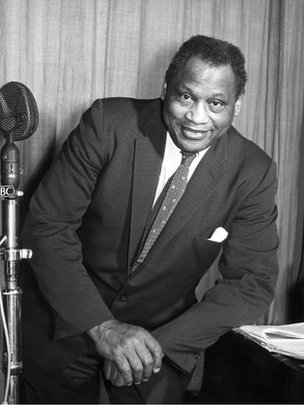
Paul Robeson, pictured in 1958, had his passport revoked by the US Government from 1950 - 1958

Paul Robeson, pictured in 1958, had his passport revoked by the US Government from 1950 – 1958

Fifty six years ago, on 9 May 1958, the singer Paul Robeson gave a famous comeback concert at Carnegie Hall in New York.

One of the most popular singers of his era, Robeson had been placed on a list of Americans suspected of allegiance to Moscow and for years was barred from performing. Susan Robeson remembers him both as a grandfather and as a resolute campaigner for civil rights in America

As a teenager Susan Robeson spent a lot of time with her grandfather Paul. Her memories are keen and affectionate.

She’s a private and thoughtful person not always at ease with the glare of publicity. But since the death last month of her own father, Paul Robeson Jr, she is the family member left to tell the world about a unique and controversial figure in American culture.

“I grew up in the period when my grandfather had his passport revoked by the State Department in Washington. For eight years from 1950 he couldn’t travel so I got to know him better than I might have done. The US Government was obsessed with silencing him.

“President Truman even signed a specific executive order restricting my grandfather to the continental United States, so he couldn’t even go to Canada. It was repressive and absurd.”

Paul Robeson had been born in 1898 in Princeton, the son of a Presbyterian minister. At Rutgers university in New Jersey he showed both academic and athletic skill before going to study at Columbia in New York City. Though he trained for the law, as a young man his looks and superb bass voice pushed him toward a career in acting and singing.

As a singer he tackled everything from Broadway show tunes to folk songs to spirituals and parts of the classical repertoire.

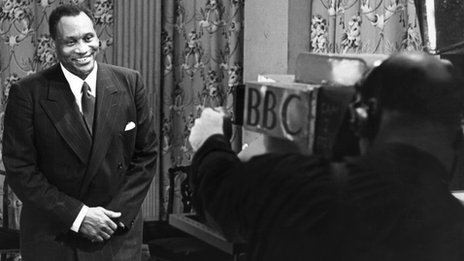
Robeson made his first post-war TV appearance in 1949 on the BBC's magazine show Picture Page

Robeson made his first post-war TV appearance in 1949 on the BBC’s magazine show Picture Page

But Susan Robeson says her grandfather always encountered racial prejudice, from childhood onwards.

“It went right through his college years and later when he was an artist trying to make his way. He grew up at the turn of the century when America was an apartheid society.

“In 1928 he was offered the chance to appear in the London premiere of the musical Show Boat.

He thought African Americans needed to understand the struggles around the world and connect with them.—Susan Robeson

“He felt there would be less prejudice there and he ended up staying for about a decade. London was where his film career emerged and he made a lot of recordings. So he did well financially but he knew that as an African American he was the exception who stood out.”

Susan Robeson says her grandfather’s political instinct also developed in Britain.

“He really emerged as someone who spoke out about independence for the colonial world. He linked the conditions of African Americans to colonised people all over the world. He saw it as one and the same struggle.

“It was something he was very outspoken about. And when he came back to the States at the beginning of the war he brought that global awareness with him. He thought African Americans needed to understand the struggles around the world and connect with them.”

‘Surprised’ by his recording

“He had a credo in the era when fascism was on the rise in Europe. He said the artist needed to elect to fight for freedom or for slavery. It was as simple as that.”

That credo involved aligning himself with communism in the US, though he denied ever becoming a party member.

Susan Robeson points out that the Communist Party was entirely legal.

“People now sometimes hear his recording of the Hymn of the Soviet Union and are surprised,” she says.

“But at the time America and the USSR were military allies. Without the USSR Hitler and his army would never have been defeated.”

Robeson [third from left] picketed in front of the White House in 1949 to "end discrimination at the Bureau of Engraving"

Robeson [third from left] picketed in front of the White House in 1949 to “end discrimination at the Bureau of Engraving”

What outraged some in America were Robeson’s reported comments at the Peace Congress held in Paris in April 1949.

Exactly what he said has been disputed. The gist as reported in the press was that black people in America shouldn’t see the Soviet Union as the enemy because a greater threat was bigotry at home.

Robeson, one of America’s best-known performers, was now firmly on the FBI list of Soviet fellow travellers. In 1950 his passport was cancelled. Susan Robeson says it was a severe burden for someone who made much of his living from touring abroad.

“When the passport was revoked the FBI came to retrieve it,” she says.

‘Virtual prisoner’

“He demanded to be told why so they put in a call to the State Department. He was told that when he travelled abroad he spoke out against colonialism and advocated for African independence. They said that was against the best interests of the United States.

“My grandfather was exercising his rights under the constitution and because of that he was made a virtual prisoner in his own country. Those so-called reasons for withdrawing his passport were unconstitutional.

He was told that if he would write… a letter promising to abstain from political statements he would get his career back. And my grandfather said no.—Susan Robeson

“From 1949 the FBI put pressure on concert halls not to allow him to sing. No recording company would issue a contract and he disappeared from the radio. Here was a man who’d been used to selling out the biggest theatres in the country and now only a few small venues would offer him work – generally black churches and community centres.

“At one point the US Secretary of State Dean Acheson offered him a deal. He was told that if he would write Acheson a letter promising to abstain from political statements he would get his career back. And my grandfather said no.”

Eventually in 1958 a case before the US Supreme Court (Kent v Dulles) established that the government had no right to withhold passports for reasons of party political allegiance. The previous year America’s red-baiter in chief, Senator Joe McCarthy, had died. Times were changing.

‘He’d fought and won’

A promoter managed to secure Robeson the Carnegie Hall date in May ’58. The live album put out on the Vanguard label is still available and the warmth of the audience response is obvious.

As a small child Susan Robeson attended the concert. “Obviously it was a memorable occasion. But I remember afterwards my grandfather saying the reaction of an audience wasn’t what he now craved.

“I’m sure he must have enjoyed all the applause but what meant most to him was that he’d fought and won. The attempt to silence him failed.”

About five years after the concert Paul Robeson more or less retired. There were those who would have liked him to take an active part in the civil rights movement of the 1960s but for the rest of his life his health was often poor. He died in 1976.

Bitterness comes from regret and my grandfather had no regrets ever.—Susan Robeson

Susan Robeson is proud that her grandfather helped lay the groundwork for the social changes of the 1960s.

“He was never bitter. Bitterness comes from regret and my grandfather had no regrets ever.

“What he was advocating was an early form of black power but he was doing it in the 1950s. He had the satisfaction of seeing the world change. A lot of the things he paid such a price for saying came to be accepted. I remember he told me his watch had always been running fast.”


>via: http://www.bbc.com/news/entertainment-arts-27291682


daily kos

TUE MAY 27, 2014


 photo NatashaTrethewey_zps9f8f775b.jpg

A thank you to the “PLOTUS”

— Poet Laureate

Natasha Trethewey


Commentary by Black Kos Editor Denise Oliver-Velez


In 2012, Natasha Trethewey was appointed as State Poet Laureate of Mississippi and also   became the 19th U.S. Poet Laureate. In 2013, she was appointed for a second term.

In June, a new poet laureate will be appointed, but before Trethewey leaves, I wanted to take a moment to say “thank you”.

Thank you for your poetry and prose.

Thank you for representing so much of what we as women, as black women, as Americans face in today’s world.

Thank you for weaving so much history into what you write.

Thank you for exploring the complexities of race, racism and identity and oppression.

Thank you for portraying those who are often forgotten.

Trethaway is a daughter of the south.

Trethewey was born in Gulfport, Mississippi, on April 26, 1966, Confederate Memorial Day, to Eric Trethewey and Gwendolyn Ann Turnbough, who were married illegally at the time of her birth, a year before the U.S. Supreme Court struck down anti-miscegenation laws with Loving v. Virginia. Her birth certificate noted the race of her mother as “colored”, and the race of her father as “Canadian”…

The American Civil War makes frequent appearances in her work. Born on Confederate Memorial Day—exactly 100 years afterwards—Trethewey explains that she could not have “escaped learning about the Civil War and what it represented”, and that it had fascinated her since childhood. For example, Native Guard tells the story of the Louisiana Native Guards, an all-black regiment in the Union Army, composed mainly of former slaves who enlisted, that guarded the Confederate prisoners of war.

We have just celebrated another memorial day, and yesterday I turned to Tretheway’s workNative Guard.

Through elegiac verse that honors her mother and tells of her own fraught childhood, Natasha Trethewey confronts the racial legacy of her native Deep South — where one of the first black regiments, the Louisiana Native Guards, was called into service during the Civil War. Trethewey’s resonant and beguiling collection is a haunting conversation between personal experience and national history.

Elegy for the Native Guards

The Daughters of the Confederacy
has placed a plaque here, at the fort’s entrance—
each Confederate soldier’s name raised hard
in bronze; no names carved for the Native Guards—
2nd Regiment, Union men, black phalanx.
What is monument to their legacy?

We have had a lot of heated discussion recently about women and violence. Tretheway’s life is no exception to what so many women have been affected by. Her mother was murdered by her ex-husband Joel Grimmette.

Trethewey’s mother, Gwendolyn Ann Turnbough, was killed by her ex-husband on June 5, 1985. At the time of her death, Turnbough was director of personnel for DeKalb County Health Department. “My mother was an educated woman, someone with all the resources at her disposal to escape a violent marriage, and yet even she could not get away,” Trethewey said. The patriarchal nature of society at the time put abused women at risk and may have sealed Turnbough’s fate. “There were no ways for my mother to hide, and yet she did everything she could to hide.”The poet read from a 13-page narrative, handwritten by her mother and found in her briefcase the morning of her murder. “You might not think such a voice is appropriate for a celebratory event, but I believe that to hear her in her own words is to celebrate the ongoing work of the people here at the center to make a difference in the lives of women,” Trethewey said before reading. The calmly written, focused narrative foreshadowed her daughter’s gift for language:

“I always knew that I would get out of my marriage. It was one of these things that never should have happened. The reason it did was a combination of emotional blackmail and physical threats and intimidation. Since he always said that he wasn’t happy either, I assumed that we would back out gracefully when our son left for college. So on each of his birthdays, I counted off one more year. I got down to eight.”

With the undulating inflection she uses when reciting her poetry, Trethewey continued reading her mother’s words and noted, “It is perhaps in the wake of those things that I must have become a writer, believing in the power of a woman’s voice, the power to be heard, to have the kind of agency that might change things.”

About those who are forgotten, in the NY Times announcement of her initial appointment Charles McGrath wrote:

Ms. Trethewey’s great theme is memory, and in particular the way private recollection and public history sometimes intersect but more often diverge. “The ghost of history lies down beside me,” she writes in one of her poems, “rolls over, pins me beneath a heavy arm.”She has devoted much of her career to resurrecting or recreating the histories of people who don’t often make it into poetry books. Her first volume, “Domestic Work” (2000), is about just what the title says: black maids, washerwomen, factory workers. One of the poems begins:

“The eyes of eight women

I don’t know

stare out of this photograph

saying remember.”

Our lives are often ironic. Tretheway has risen to the heights of achievement, yet while she was being awarded the 2007 Pulitzer Prize for Poetry for her “Native Guard”, her  younger brother was being arrested on drug charges.


For U.S. Poet Laureate Natasha Trethewey, the visit to the King County Juvenile Detention Center brought back vivid memories of visiting her brother in jail after he was convicted of a drug offense. Watch her read her poem “Benediction” about the day he was released from prison.

Beyond Katrina: A Meditation on the Mississippi Gulf Coast was published in 2012.

Beyond Katrina is poet Natasha Trethewey’s very personal profile of the Mississippi Gulf Coast and of the people there whose lives were forever changed by hurricane Katrina.Trethewey spent her childhood in Gulfport, where much of her mother’s extended family, including her younger brother, still lives. As she worked to understand the devastation that followed the hurricane, Trethewey found inspiration in Robert Penn Warren’s book Segregation: The Inner Conflict in the South, in which he spoke with southerners about race in the wake of the Brown decision, capturing an event of wide impact from multiple points of view. Weaving her own memories with the experiences of family, friends, and neighbors, Trethewey traces the erosion of local culture and the rising economic dependence on tourism and casinos. She chronicles decades of wetland development that exacerbated the destruction and portrays a Gulf Coast whose citizens—particularly African Americans—were on the margins of American life well before the storm hit.

So, thank you Natasha Trethewey. But not good-bye. I’m reading Thrall, and looking forward to a wealth of insights from your pen in the years to come.

(note: Trethewey was one of the poets launched by the Dark Room Collective – see story below)


>via: http://www.dailykos.com/story/2014/05/27/1301917/-Black-Kos-Tueday-s-Chile?showAll=yes


Mosaic Literary Magazine

May 12, 2013


dark room collective

Dark Room Collective: Essay


By Sharan Strange


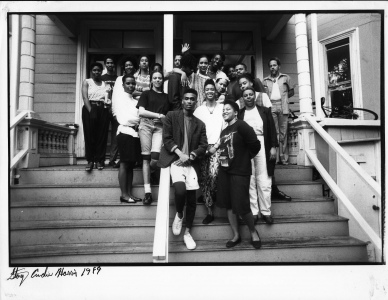
When James Baldwin died in 1987, a group of Cambridge, Massachusetts housemates—among us, aspiring writers and filmmakers—made a pilgrimage to his funeral in New York. It was winter and typically dreary when we heard, and though we were stung by the news of death, we felt a sense of urgency, a need to go and be among the mourners, to acknowledge his passing in a communal way. As we made our way by car to Baldwin’s native city, each of us reflecting, perhaps, on what his life and work had meant to us, amid the somberness of that occasion sat the stark realization that he was truly lost to us. He’d been here among us all those years; I had even attended a tea at Harvard and stood in the same room with him, too shy to break through the thick clot of fans around him and offer the admiration he had been accustomed to for decades. Now he was gone and we could never hear him speak his words in person, never have a conversation with him, never clasp his hand. We had read the biographies and critical studies and knew what a complex, reputedly difficult figure he was. But he was our brilliant treasure; we had claimed him and we went to pay our respects.

……………………………………………………………………….
This essay first appeared in Mosaic #16, Fall 2006
……………………………………………………………………….

Dark Room Collective

The funeral was a literary event, like a reading or book party. All our literary icons were there. Toni Morrison, Maya Angelou, and Amiri Baraka eulogized Baldwin, and it was thrilling to hear Baraka describe him as “God’s own revolutionary black mouth.” It was something no funeral is supposed to be: a heady affair. Yes, we went to say farewell to “Jimmy,” but our sense of loss couldn’t truly match that of the people who had actually known him. We felt somewhat like distant young cousins of a family patriarch whose passing we felt as momentous but could be met without the deepest sorrow for we had known him only from a distance. Instead, our sorrow was suffused with a kind of energy, a desire to make something positive out of loss, and so we resolved that we wouldn’t let another of our literary elders get away from us. In traditional Black culture elders are always teachers, role models. Through his writings and activism, his humanism and his vision, Baldwin had given us an example of passionate engagement with life. Like the griots of West African culture, he and other Black writers bear witness to our collective struggles and survival. And like countless other writers before them, they have made vital contributions to American literature and the African American artistic tradition. We wanted to affirm the sustaining value of their commitment and acknowledge our debt to them. So we left St. John the Divine Church in Harlem and went back to Cambridge with an idea.

Upon our return, my housemate Thomas Sayers Ellis and I began to make plans to formally connect with and honor other still-living Black writers, whom we dubbed our “living literary ancestors.” We were already involved in a project of building an extensive library of writings by Black authors of the Diaspora, including first editions and out-of-print publications. We had named it “The Dark Room: A Collection of Black Writing” because it was housed in a former photographic darkroom on the third floor of the old Victorian house we shared with four other artists/students in Central Square. The words were already emblazoned on the door and we liked the pun it provided on a room full of “black books.” The metaphor of a darkroom was also apt: a place where images develop, brought forth in darkness into light. Incubator. Womb. Only afterwards did we realize the affinity with the Dark Tower—named after Countee Cullen’s poem—the gathering of Harlem Renaissance artists in A’lelia Walker’s salon.

In the spring of 1988 we began planning the Dark Room Reading Series. Ellis and I had been attending readings around Boston and Cambridge where we heard many of the luminaries that such an intellectual center draws, but we noted the paucity of Black writers and other writers of color invited to read at those events. Yet Derek Walcott was teaching at Boston University and Samuel Allen was emeritus professor there. Ishmael Reed was visiting at Harvard. Other well-known writers were to be found at outposts in western Massachusetts and other nearby New England communities. Why weren’t they more frequently seen? And what about the not-so-celebrated writers who were doing good work? Didn’t the curators of those reading series peruse the bookstores or the journals? Or was it considered too difficult to bring those folks to town—to Cambridge, a place with deep intellectual, cultural, and financial resources? That could hardly be the case. Or, was there a disdain for or, perhaps worse, sheer lack of interest in any but the most celebrated, established writers of color? Local emerging writers also seemed to go unnoticed by the curators of series at the public libraries and university English and writing departments. Who would nurture and promote their work? Ellis and I had discovered numerous writers in journals and on bookstore shelves and we had become acquainted with several local writers. We wanted to hear them read their words, have conversations with them, clasp their hands. We wanted them to know that their work was appreciated, was inspiring, was changing lives. We wanted to know them and to have them know us.

During that time we met Janice Lowe, a musician who also wrote poems, and she joined us, agreeing to organize art exhibits to accompany the readings. We also met Jon Ewing, a journalist who was enthusiastically absorbing the writings of Primo Levi and trying his hand at experimental prose; he also joined us. And by March 1989—after treks across the river to invite Walcott to read in our living room; to Brown University in Providence to coax Michael S. Harper (whom we greeted with the following message from Walcott: “I command you like a West Indian general to read for these people!”); to New York to meet Clarence Major; to our “backyard” (Harvard) to talk with Reed; to Tufts to meet Baraka; to Brandeis to meet Morrison; to Amherst to meet Samuel Delany and John Wideman; and to the Victor Hugo Bookstore in Boston’s Back Bay to meet Sam Cornish, just some of the “headliners” we photographed and hoped would sign on to the venture—we had created a reading series that eventually went beyond our initially modest and somewhat selfish goals. We reached out to writers, artists, musicians, journalists, editors, critics, arts organizations, academic institutions, activists, merchants, students, and just plain folks. We met on Sunday afternoons after church and for some of us it was church. Clarence Major’s succinct declaration became our anthem and benediction: Total life is what we want! Ultimately, the series helped to create a diverse artistic community where before a void had existed. And we noted, with great satisfaction, the reverberations beyond our house: other collectives were formed, new reading series sprang up, and Black writers started to come out of the woodwork.

In two seasons at our house at 31 Inman Street—which began with readers Quincy Troupe and Dorchester’s Darryl Alladice and ended with Terry McMillan and Danielle Legros-Georges—numerous readings paired established and emerging writers such as Walcott, Alice Walker, Ntozake Shange, Yusef Komunyakaa, Samuel Delany, Toni Cade Bambara, John Wideman, Dolores Kendrick, Dennis Brutus, Martín Espada, Elizabeth Alexander, Randall Kenan, Pearl Cleage, Trey Ellis, Essex Hemphill, Melvin Dixon, Patricia Spears Jones, Pat Powell, Michael Thelwell, Cornelius Eady, Carolivia Herron, Barbara Neely, Cyrus Cassells, Sam Cornish, Carolyn Beard Whitlow, Tim Seibles, Xam Cartier, and Kate Rushin, among others. Painter Ellen Gallagher, then a student at Boston’s School of the Museum of Fine Arts whom we met on the bus to Providence on our way to meet Harper, also joined us to curate our exhibitions of established and rising local artists, among them Bryan McFarlane, Ife Franklin, Vusumuzi Maduna, Roxanne Perenchief, and Kirstin Gabler. Two highlights of the second season were a marathon reading of Bob Kaufman’s works as a tribute to the late North Beach poet who coined the term “Beat poetry,” and an evening of collaboration and reminiscences by three long-time friends—novelist Leon Forrest, sculptor Richard Hunt, and composer T.J. Anderson, Jr.—at the historic African Meeting House in Boston.

As we reached out to claim and nurture our literary avatars, many of them reached out to us first: Scholar and critic Mary Helen Washington was an enthusiastic friend who brought us Alice Walker and Toni Cade Bambara, who both had sought out our series because they wanted to support our efforts. Both read without demanding an honorarium—as did Walcott, as did the other writers in those beginning seasons when we had to pool our meager finances to pay for airfare, hotels, and the group dinners that usually capped the day. One day we got a call from Gloria Joseph who had heard about our book collection and wanted to contribute several boxes of books that she and Audre Lorde had amassed in St. Croix. The energy flowed in both directions between us and our ancestors and elders. We received crucial assistance in other ways too: Callaloo editor Charles H. Rowell, a long-time champion of our cause, agreed to introduce Terry McMillan in the final reading at the Inman Street house, and later solicited our work for publication in the journal. And Don Lee, editor of Ploughshares, volunteered the journal as a fiscal sponsor for the grants that helped the series to transition to a larger venue.

With listeners spilling out into the hallway, stairs, and front porch, the readings eventually outgrew our living room. The series then moved to the Institute of Contemporary Art in Boston where our mission became twofold: to continue to build community around our celebration and support of Black and other artists of color, and also to make the museum more accessible to certain communities that it had failed to connect with in the past. The larger space—and funding to pay the writers—allowed us to accommodate our growing audiences, but it lacked the afro-bohemian flavor, the informal hospitality that we had cultivated at Inman Street. So we added a jazz band, Salim Washington and the Roxbury Blues Aesthetic, to the mix. Michael Harper, Al Young, Nathaniel Mackey, Harryette Mullen, Thylias Moss, Walter Mosley, Greg Tate, Arthur Jafa, Toi Derricotte, Helen Elaine Lee, Carl Phillips, Paul Beatty, and Natasha Tarpley were some of the featured readers. Radcliffe’s Bunting Institute director Florence Ladd (mother of poet Michael Ladd), film scholar Clyde Taylor, and Northeastern University professor (at the time) and literary archivist Maryemma Graham, among others, became patrons. We also incorporated another way of paying tribute with the Dark Room Awards—original works of art by Vusumuzi Maduna and Benny Andrews —given to Yusef Komunyakaa and Thylias Moss for poetry, and to Samuel R. Delany for fiction.

In its final season in 1994, the Dark Room Reading Series moved to the Boston University Playwrights’ Theatre (then under the direction of Walcott). By the time the series came to a close, we had added discussions by playwrights and talks by cultural critics to our usual offerings of poetry and prose fiction, with readers such as Amiri Baraka, Sonia Sanchez, Afaa Michael Weaver, Erica Hunt, David Henderson, Shay Youngblood, Marilene Phipps, Dominic Taylor, and Willie Perdomo. In the short span of five years we had hosted over 100 writers, not to mention numerous visual artists and musicians. We weren’t organizing poetry slams but we were similarly populist in our ethos. We wanted to make room for more voices and to provide a venue where we could begin to diminish those common barriers to appreciation of a broader spectrum of voices: biases around race, class, gender, sexuality, culture, ideology, etc. What started as an “underground” venture, so to speak, may have capitulated to the museum and the university in the end, but not, I think, without changing those places in important ways.

The most discernible changes, however, were in our individual lives as writers. Our original band of four had not anticipated the overwhelming response the series would get, and after our inaugural season it became clear that we needed more support. Thus we conceived of a collective of young writers who would pay dues, literally and figuratively, by organizing the series and nurturing and learning from each other as artists. The Dark Room Collective formed in our second season, when we began to alternate our weekly public readings with critique sessions for a small group of earnest aspirants to that literary pantheon we were hosting. New members joined in rapid succession; some we had met at literary events as we scouted the town for readers; others had seen our neon-bright posters modeled after the go-go show posters of Ellis’s native D.C., or received the homemade flyers and cards I had designed and which we gave out all over town; others had returned to the series week after week, lured by the sharing, fun, and serious purpose that infused the atmosphere. Some of us had been writing in virtual isolation for years; some were currently in writing classes at Harvard and other schools; some, like myself, had begun to write seriously only as a result of being involved in the Dark Room. The Collective, then, became a catalyst for a higher level of engagement with writing and nourished a hunger we all had for affirmation of our incipient steps as writers—not just from peers, but from our elders, those “living literary ancestors” that we had begun to dialogue with through the reading series. Thus began our real apprenticeship—the reading series and our workshops were in a sense our true MFA writing program. Later, as we grew in craft and confidence, we traveled and read our works together, incorporating a ritual of honoring our literary ancestors at each of our presentations.

The Collective readings helped not only to keep us connected as we increasingly dispersed to pursue graduate study, fellowships, jobs, and various creative endeavors, but they also allowed us to expand our notion of writing community as we met and read with peers in other places. Our first official reading as a collective, in August 1990, was number 101 in the Ascension Reading Series organized by E. Ethelbert Miller in Washington, D.C. We went on to establish relationships with, and read at programs hosted by, other writers’ groups on the thriving ‘90s literary scene in Chocolate City: the 8-Rock Collective of Anacostia (Kenneth Carroll, Brian Gilmore, Judy Cohall, and DJ Renegade) and the Modern Urban Griots, whose members included Toni Asante Lightfoot, Holly Bass, and Brandon Johnson, and whose hugely popular open mic sessions at the It’s Your Mug café filled Georgetown’s streets in the evenings with young Black folks.

We also found community in Philadelphia, meeting writers associated with Twelfth House—Major Jackson and Nehassaiu de Gannes (both later joined the Collective) and Ursula Rucker, among others—and reading at the Painted Bride, with an introduction by Ntozake Shange who had graciously put the whole Dark Room Collective up at her house! In our informal gatherings at the Brooklyn apartment of Naadu Blankson and at venues like mosaicbooks, Blackberry’s, and the Nuyorican Poets Café, we met and read with Paul Beatty, Asha Bandele, Kevin Powell, Tish Benson, Willie Perdomo, Sabah as-Sabah, Tony Medina, Tracie Morris, and other New York writers and artists. And at the National Black Arts Festival in Atlanta we made connections with Midwest writers Jabari Asim, Ira Jones, and Andrea Wren—younger associates of literary elder and mentor Eugene Redmond—who curated programs at the Vaughn Cultural Center in St. Louis and solicited some of our writings for Eyeball and Young Tongues, publications of their First Civilizations Press.

But the high point of all that traveling and bonding was the first Furious Flower Conference, which celebrated the Black poetic tradition and, in particular, the life and work of Gwendolyn Brooks. Convened at James Madison University in the fall of 1994 by Dr. Joanne V. Gabbin—former student of Sterling Brown and scholar of his work and Brooks’s, among others—the conference brought together authors, scholars, and publishers of Black poetry from across the country, the generations, and the broad spectrum of voices, from publishing pioneers like Naomi Long Madgett to icons of the Black Arts Movement to their inheritors. Members of the Dark Room were ecstatic to be invited to participate in such a watershed event in African American literary history and to share the stage with writers whom we had cut our teeth on.

After giving readings and workshops from Maine to Miami over the course of almost a decade, the last performances by the Collective were the Drive-By Readings of 1996-1998. By then we had become a solid ensemble of readers, attuned to our individual strengths and the ways in which we complemented and supported each other. With more stylized programs that incorporated “sets” of our works, props, music, and intermissions we were able to offer our audiences the diversity of our voices with a bit of the flair that characterized our original reading series.

Now nearly twenty years later, the Dark Room Reading Series has extinguished its lights and the Dark Room Collective has scattered to different states and countries. But the work begun there continues. Former Dark Room members have published and continue to publish collections of their poetry and prose, edit anthologies, teach writing workshops and literature classes, give public readings and lectures, read and advise at major journals, and curate reading series. With the abiding spirits of James Baldwin, Bob Kaufman, Audre Lorde, Ralph Ellison, Melvin Dixon, Leon Forrest, Margaret Walker Alexander, Pat Parker, Toni Cade Bambara, Essex Hemphill, Sabah as-Sabah, Sherley Anne Williams, Dudley Randall, Barbara Christian, Gwendolyn Brooks, Raymond Patterson, Tom Dent, Safiya Henderson-Holmes, Ted Joans, Pedro Pietri, Thomas Grimes, June Jordan, Lorenzo Thomas, and the host of their—and our—literary forebears, we continue a rich legacy, naming and claiming our own.

The Dark Room Collective (1989-1998)
Thomas Sayers Ellis (The Genuine Negro Hero; The Maverick Room), Sharan Strange (Ash), Janice Lowe, Jon Ewing, Tisa Bryant (Tzimmes), Trasi Johnson, Aya de León (Live at La Peña), Della Scott, John R. Keene (Annotations), Rich Britton, Donia Allen, Donette Wilson, Patrick Sylvain, Danielle Legros-Georges (Maroon), Artress Bethany White, Tracy K. Smith (The Body’s Question), Kevin Young (Most Way Home; To Repel Ghosts; Jelly Roll; Black Maria), Murad Kalam, formerly Godffrey Williams (Night Journey), Kambui Olujimi, Carl Phillips (In the Blood; Cortège; From the Devotions; Pastoral; The Tether; Rock Harbor; The Rest of Love), Muhonjia Khaminwa, John Searcy, Gina Dorcely, Maya Trotz, Nelly Rosario (Song of the Water Saints), Ellen Gallagher (Blubber; Preserve; Exelento; Murmur), Salim Washington, Adisa Vera Beatty, Major Jackson (Leaving Saturn; Hoops), Natasha Trethewey (Domestic Work; Bellocq’s Ophelia; Native Guard), Nehassaiu de Gannes (Percussion, Salt & Honey), Audrey Petty, David Wright (Fire on the Beach), Jahmae Harris.

The Dark Room Extended Family
Noland Walker, Kelly Sloane, Sonya Brown, Stacey André Harris, Maritza de Campos, Bethany van Delft, Dina Strachan, Jade Barker, Jorge Otaño, Mackie Burnett, Kevin Keels, Philecia Harris, Blondel Joseph, Toni and Wyatt Jackson, Mark Leong, Marcus Alonso, Vuzi Maduna, Mark Griffith, Charles Rowell, Ntozake Shange, Clyde Taylor, Mary Helen Washington, Maryemma Graham, Richard Hunt, Florence Ladd, Joanne V. Gabbin, Askold Melnyczuk, William Corbett, Kay Bourne, Don Lee, Eve Stern, André Caple, Yvette Mattern, Kwaku Alston, Jacquie Jones, Gelonia Dent, and many more.


>via: http://mosaicmagazine.org/blog/?p=2616#.U4qyZhax9Lr
 

Be About Beauty


be about beauty

as strong as a flower is

yet as soft too

as an open petal

receiving the mist

of a midnight raindrop,

be about beauty

no matter life’s dirt

be about beauty


—Kalamu ya Salaam

creative quilt by Adrienne Cruz (http://www.adrienecruz.com)


“The art I create fulfills a powerful desire to express visually what’s not easily spoken. I am moved by a passion for color, a love of symbols, and a deep interest in matters of the Spirit. Blending these elements keeps the rhythms of my roots alive by acknowledging the gifts of my ancestors, angels, and spirit guides. The power of art, beyond its visual image, is developed over time – born of the spirit, of roots, and the celebration of survival.

“I welcome you to journey through this site for a taste of my world of art as meditation, a great source of joy and peace I share with you. May your spirit be lifted and inspired! Thank you for visiting.”                Adriene Cruz 


Life should be Beauty, Magic and Joy
Smile, love, laugh and laugh some more
Our birthright is to know joy and experience pleasure
A spirit fueled with joy is charged and ready to go about the work we’re here to do.


It’s true we won’t always be happy or even feel good. 

The challenge is managing to remember our birthright when the burdens get us down. Transform grief to beauty and dream something wonderful.  

In my life, the experience of love and beauty has been the best medicine for elevating a beat down spirit. As in the beauty of … 
A smile 
Good music Dancing, dancing, dancing
Travel to new and familiar places
Forgiveness
Understanding
The love a support of family and friends
Children laughing
Kind words
Working out
My happy dog
Faith infused with courage
Selfless giving
Love, love, love
Flowers, trees, sunsets, walks by the river, a moonlit sky, and all the wonders of nature’s abundance …
The beauty of finding magic in everyday life
To have magic in our lives is to remember it’s real, profound and sacred. Enjoy! For generations, the women in Adriene Cruz’ family have been sewing and designing clothing. A native of Harlem, New York, Adriene attended the High School of Art and Design, then the School of Visual Arts graduating with a BFA. In those years Adriene worked in wood sculpture, often with fiber elements, and gradually the fibers, especially tapestry crochet, became her primary focus, linking her art more directly to those traditions in her family.


In 1983, Cruz moved to Portland, Oregon, where a quilting course at the Oregon School of Arts and Crafts reinvigorated her artwork. Since then, she has been creating brilliantly colored and adorned quilts, piecing together richly patterned materials in rhythmic arrangements that are stately as well as exuberant, structured as well as improvisational, deeply moving on a spiritual level as well as simply enjoyable for their sheer beauty.

The resonant depths of these works arise from many factors: the relationship of the materials to Adriene’s ancestry; the warmth and comfort; the powers and symbolic qualities of cowrie shells, mirrors, and talismans; the artist’s ability to connect viewers to the rhythms, shapes, and patterns of abundant life

Adriene’s gifted use of color and design has also garnered attention for public art in the Portland community. She has created street banners and painted murals, and created the installation art for the Killingsworth Light Rail Station using glass concrete and steel. In addition to museum exhibits nationwide, Adriene has been featured in numerous books and publications.

CONTACT INFORMATION: Adriene may be reached by email.