HBCUSTORY SYMPOSIUM 2014 Theme | Where Do HBCUs Go From Here? Strategic Partnerships + Sustainable Futures
In partnership with the Association of Public Land-grant Universities (APLU),HBCUstory, Inc. proudly presents the 2014 HBCUSTORY SYMPOSIUM in Washington, D.C. on October 24-25, 2014. The two-day research and cultural symposium is first of its kind for the nation’s 105 Historically Black Colleges and Universities (HBCUs). A national convening of Historically Black College and University (HBCU) researchers, presidents, administrators, faculty, staff, students, and alumni, the symposium has a two-part focus: ● Theoretical, offering academicians and advanced students opportunities to share their current work on HBCUs. ● Practical, offering practitioners opportunities to shed light on the most successful programs and best-practices currently underway at HBCUs around the nation.
Call for Papers, Organized Sessions and Panel Guidelines June 15, 2014 is the deadline for abstracts and sessions. The two-day symposium’s registration cost of $100 includes lunch. An early-bird registration rate of $75 is available for a limited time.
Registration is available online at: http://www.hbcustorysymposium2014.eventbrite.com.
The 2014 HBCUstory Symposium Planning Committee invites proposals that meet one or both of the following criteria:
● The presentation is related to a preeminent HBCU figure (alumnus, alumna, administrator, faculty member, etc.) or to a single, group and/or all HBCUs from their founding to today. Presentations may address a variety of topics including history, information science; STEM; fundraising and development; partnerships and mergers, student persistence and retention; diversity and inclusion (LBGTQ, women studies); as well as athletics and wellness. Possible topics may be historical, investigative or scientific in nature.
● The presentation is related to a highly successful program, initiative or practice currently underway at a single, group and or all HBCUs.
Presentations relating to HBCU partnerships are especially welcomed. Presenters are not required to have an HBCU affiliation. The committee accepts proposals for single papers but encourages session proposals that include two or three papers.
Single paper proposals and organized sessions must include: Paper Title Abstract (200 word limit) HBCU + Nature of HBCU Affiliation (if applicable) Submitted by (list name, institution, title, mailing address, email)
The Committee accepts proposals for panels of three persons which must include: Panel Title Suggested Panel Chair Brief Panel Description (250 word limit) List of Panelists (list name, institution, title, email) HBCU, Nature of HBCU Affiliation (if applicable) Submitted by (list name, institution, title, mailing address, email)
Early-bird registration is strongly encouraged for favorable consideration.Please make all submissions and/or inquires to the HBCUstory Symposium 2014 Convenor Crystal A. deGregory, Ph.D. via email at cadegregory-at-hbcustory-dot-com.
The Rupkatha Journal on Interdisciplinary Studies in Humanities
contact email:
editor@rupkatha.com
The Rupkatha Journal on Interdisciplinary Studies in Humanities www.rupkatha.com Special Issue on Indigenous Literatures
(Volume VI, Number 2, 2014) Broad Areas of Submission:
Literature of North East India South Asian Indigenous Politics & Literature Native American Issues Australian Aboriginal Feminist Indigeneity Chicano African Literature Folklore Nativism Ethnography
Word-limit:
Papers should be between 3000-5000 words. Book reviews should be between 1000-1200 words for single and/or double book reviews.
No Submission Fees: Rupkatha is a non-profit initiative. We never charge or accept any amount of money in the name of Processing Fee or Subscription or other dubious Fees. We neither pay nor accept any amount of money. Submitting with us is a purely non-monetary academic transaction
Starz’s highly anticipated new original series Power will debut a week from today, on Saturday, June 7th at 9pm ET/PT. Ahead of that premiere, the network has released the season’s premiere episode online, as part of a multi-platform, nationwide sampling of the first episode.
From the press release:
Power is the first-ever television show to premiere on Twitter using the service’s new in-line video feature that enables one-touch playback. The new video experience is based on Twitter Cards, which extends user interactions beyond favoriting, retweeting and replying and makes it possible for people to do things like watch videos, download apps, or view articles and photos — all from within a Tweet. Select multi-channel video distributors will offer linear, on-demand and online sampling opportunities of the first episode beginning today, May 31, one week in advance of the TV series premiere next Saturday. Approximately 79 million multichannel video households will have access to the sampling opportunities through select cable, satellite and telco affiliates in the United States.
The first episode of Power will also be available at www.starz.com/power, and online through select Starz cable, satellite, telco, and online distributors’ websites, including the Starz Power Twitter page at https://twitter.com/starz_channel, Starz Power MySpace page, the Starz YouTube page at http://www.youtube.com/user/Starz, Starz Power Facebook page at www.facebook.com/power.starz, Amazon Instant Video, Vudu, Sony Entertainment Network and CinemaNow.
The series premiere of Power will also be available for sampling through the free Starz Play app for all users in the United States.
Executive produced by Curtis ‘50 Cent’ Jackson, Power isa crime drama set in two different worlds – the glamorous New York club scene and the brutal drug trade.
James “Ghost” St. Patrick has it all: a beautiful wife, a gorgeous Manhattan penthouse, and the hottest, up-and-coming new nightclub in New York. His club, Truth, caters to the elite: the famous and infamous boldface names that run the city that never sleeps. As its success grows, so do Ghost’s plans to build an empire. However, Truth hides an ugly reality. It’s a front for Ghost’s criminal underworld; a lucrative drug network, serving only the wealthy and powerful. As Ghost is seduced by the prospect of a legitimate life, everything precious to him becomes unknowingly threatened. Once you’re in, can you ever get out?
The cast is led by Omari Hardwick who is joined by Lela Loren, Naturi Naughton and Joseph Sikora. Hardwick stars as ‘James “Ghost” St. Patrick’; Loren plays ‘Angela Valdes’, an old flame of James’s who unexpectedly reenters his life; Naughton will play ‘Tasha St. Patrick’, wife, confidant and willing accomplice to James and Sikora plays ‘Tommy Egan’, childhood best friend and business partner to “Ghost.”
Power will also feature Andy Bean as ‘Greg’, Sinqua Walls as ‘Shawn’, Adam Huss as ‘Kantos’, Greg Serano as ‘Medina’, Lucy Walters as ‘Holly’, Victor Garber as ‘Simon Stern,’ Sonya Walger as ‘Madeline Stern,’ Kathrine Narducci as ‘Lavaro’, Luis Antonio Ramos as ‘Ruiz’, La La Anthony as ‘LaKeisha’, Diane Neal as ‘Cynthia’, J.R. Ramirez as ‘Julio’, Debbi Morgan as ‘Estelle’, Shane Johnson as ‘Saxe’, Enrique Murciano as ‘Lobos’, Vinicius Machado as ‘Nomar’, Dominic Colon as ‘Anibal’, J.P. Serret as ‘Sabueso’ and Audrey Esparza as ‘Liliana’.
The series is created by Courtney Kemp Agboh, who will serve as executive producer and showrunner. Mark Canton, Randall Emmett and David Knoller also serve as executive producers. The series is being produced in association with CBS Television Studios.
Power premieres on Saturday, June 7th at 9pmET/PT on Starz with an eight hour-long episode first season.
But you don’t have to wait a week. You can watch the season premiere right now, embedded below:
The SF Black Film Festival is one of the film festivals that I most look forward to in the Bay Area every year. This year it is from June 12-15 at various theaters in San Francisco.
Kali O’Ray and his wife and partner, Katera
It was founded by the late Ave’ Montague, and now it’s under the direction of her son, Kali O’Ray. Last year’s festival featured dynamic documentaries about the legendary writer Iceberg Slim, as well as one on the prolific San Francisco born funk band leader Sly.
The year before, I saw a great movie called “The Hive” by the much sought after Black director Robert Townsend. Every year I’ve seen great films that don’t have the promotional budgets to reach a wider audience without the help of a festival like SFBFF.
I am excited to be going this year, and I hope to see you there. Here is Kali O’Ray in his own words.
M.O.I.: Can you tell people the history of the San Francisco Black Film Festival? How was it founded?
Kali: The SFBFF started as the brainchild of my mother, Ave’ Montague. My mother really appreciated the arts, and the stage and the big screen were two of her favorites.
When I was much younger she started a small business that distributed Black movies and TV shows. Now remember, this was at a time before DVDs and Netflix. This was at a time when you had to order special content and Black content was especially hard to find.
From this venture she hosted a small film festival to supplement the San Francisco Juneteenth, and from that moment the San Francisco Black Film Festival was birthed. That was 16 years ago.
M.O.I. JR: Who are some of the headlining people who have attended the festival in the past? What were some of the major flicks that you have premiered?
Kali: I have not been to every film festival because near its beginning is when I spent my time in college down South. Some of the headliners at the festivals I attended or remember were Spike Lee, Robert Townsend, Billy D Williams, Danny Glover, Taraji P. Henson, just to name some of the top off of my head.
Renowned filmmaker Robert Townsend, seated between Kali O’Ray and Jac Taliaferro, is interviewed at the 2012 San Francisco Black Film Festival.
As far as movies go, we have premiered many of the Black movies from a decade ago. I am noticing a new trend where movies go from the film festival circuit straight to online streaming or DVD. The festivals are becoming a way for people to gain exposure and a fan base to give their content more value.
It is no longer necessary to go to the big screen to make an impact. This is still the goal of some, but people are realizing that the California Gold Rush is online. As online streaming becomes more popular plus accessible, so will the competition for content which is already including independent film.
I am finding that many deals are being struck by the many companies who are seeking new content to compete for your dollar. I have been off cable for a year and getting ALL my content from the internet. There isn’t much that I miss through the countless online streaming services available. I also get to view seasons and shows on my time, when I am ready.
And now, some of the exclusives for streaming networks such as HULU or Netflix have become huge hits. I would bet dollars to donuts that the near future involves streaming taking over and bypassing the boob tube.
M.O.I. JR: What will some of the highlights be this year?
Kali: The biggest highlight of this year will be a better organized future. The ducks are lining up and that means great things for the SFBFF.
Bay Area film festival impresarios Kali O’Ray of the San Francisco Black Film Festival and David Roach of the Oakland International Film Festival.
We have gotten a couple of offers for our content, and we’re looking into streaming Black films year round. We have a niche to fill, and we are getting closer to seeing that vision.
The SFBFF gets countless films that most will not view because we often have only a couple of chances to screen them. After that moment, many of these films will be harder to locate.
And if you miss the buzz, you may not know about certain films unless you pay very close attention to independent films. These are great films that need a platform and a voice to let others know of their existence.
We want to be that voice and that platform. This would give us the option to show the thousands of films that do not get a deal but are well worth your time to see.
In addition to film, there will be many supplements to this year’s festival such as workshops and seminars. It is the mission of the SFBFF to introduce you to film as well as offer knowledge about the film business.
This is a place to get those missing pieces for your project or learn how to get your film completed DIY style. The playing field is getting much better and all you need is a good story and knowing how to film it.
M.O.I. JR: San Francisco at one time was over 16 percent Black; now it is less than 5 percent Black. What makes the SF Black Film Festival important when looking at this fact?
Kali: The festival is important for Black representation in San Francisco. It is important to celebrate our inclusion, no matter what the numbers may state. It is also important to share what is going on in the rest of the diaspora with San Francisco.
The Black films that come out every year are like checking the pulse of what it means to be Black in America. These movies tell a story of the relevance of our contribution and legacy on a yearly basis.
We are, in fact, archiving the Black experience in real time. I love what I do with the SFBFF and feel blessed to be a part of it. This is living to me and gives me breath every day.
There is nothing I want to do more than bring films and the Black experience to San Francisco and the Bay Area. These stories deserve to be heard. The Black experience is, without argument, the American experience … picture that.
“Troop 491: The Adventures of the Muddy Lions”
M.O.I. JR: San Francisco has a number of independent institutions for the Black community like the SF Black Film Fest, KPOO radio station, the SF Bay View newspaper; why do people need to support these institutions?
Kali: These institutions need to be supported to keep San Francisco as diverse as possible. Not just Blacks, but minorities as a whole make up what people love about this city. Growing up here, the diversity is what I loved about San Francisco.
These institutions are important because they are the few remaining, which shows how the out-migration is hurting San Francisco. We need to support these institutions that have supported us for many years to keep them afloat.
If they were to all disappear, then would you miss them? We all like to see something that looks like us and that we can understand. We need these places for that if nothing else … to feel a part of something. A place to represent.
“’Til Infinity: The Souls of Mischief Documentary”
M.O.I. JR: How did you feel about last year’s Black movies like “The Butler,” “12 Years a Slave” and “Fruitvale Station,” which depicted Black people as spectators of history and victims, being the only Black films to be critically acclaimed in the lame-stream media?
Kali: I enjoyed all of those films and I am always glad when Black actors are getting work. I often wish that we were the ones financially backing these movies so we could receive a bigger piece of the pie. I am glad to at least see some Black films being made but still would like to see more.
I was not fond of the slavery theme that has been on the big screen recently. I went to go see “12 Years a Slave” with a minority Black audience. I must say that I did like the movie and the cinematography but felt very uncomfortable watching with the audience that I did. It would have been a much different experience with a Black audience.
It gave me the feeling of being in high school when I had to watch “Roots” for Black History Month at a Catholic school I attended. “Your name is Toby!” Who wants to hear “Nigger this” and “Nigger that” at school. Yes, it is true we were slaves here in America, but stop making that our only history.
“Black and Cuba” (made by Blacks at Yale)
M.O.I. JR: What kind of films do you like to promote at the SF Black Film Festival?
Kali: We like to show a little of everything at the festival. Films that make you laugh and films that make you cry. We enjoy “green” films and films about healthy living.
We also like to promote positive movies that give a different look at Blacks in America. Roles that make you reach for the sky and rearrange your thought process.
Films can heal and films can teach as well. We try to let you encounter all of this at the festival and give you the ultimate experience and something that resonates long after you leave. Media is powerful and we try not to abuse the power of media with negative visions; we use the power to uplift and change your train of thought.
“Comeuppance”
M.O.I. JR: You just attended the Oakland International Film Fest. What did you think about it? What were some of the things you liked?
Kali: I enjoy the festival every year and really like what Dave (Roach) is doing with it. I like to go and seek out films as well as view other films that we do not get. Dave is a great guy and gives off great energy, so the experience is always delightful.
It is also a great place to meet others in the industry and trade stories or methods to the madness. I am proud of what he is doing over there in Oakland and look forward to next year’s as well.
M.O.I. JR: How can people get more info on the SF Black Film Fest?
Kali: Go to sfbff.org where we will be posting the schedule and special events for this year’s festival. Also check out facebook.com/sfblackfilmfestival to be abreast of films as we start to qualify them. Here you can see trailers as well as synopsis as we accept the films.
“Devil in the Detail”
“Unsound”
“Know How”
“Changing Face of Harlem”
“The View from the Other Side: J-Dilla, A European Remembrance”
Sponsored by Cave Canem and the School of Writing (http://www.newschool.edu/writing) at The New School (http://www.newschool.edu). Join Evie Shockley and Santee Frazier for a lively conversation on aesthetics, the role of the contemporary poet, and other topical issues, moderated by Camille Rankine. A brief reading precedes the discussion, and Q & A with the audience follows.
– Santee Frazier is a citizen of the Cherokee Nation of Oklahoma. He holds a BFA from the Institute of American Indian Arts and an MFA from Syracuse University. He is the recipient of various awards including: Syracuse University Fellowship, a Lannan Foundation Residency Fellowships, and most recently The School for Advanced Research Indigeonous Writer in Residence. His poems have appeared in American Poet, Narrative Magazine, Ontario Review, Ploughshares, and other literary journals. His first collection of poems Dark Thirty was released by the University of Arizona Press in 2009.
– Evie Shockley’s most recent book of poetry, the new black, won the 2012 Hurston/Wright Legacy Award in Poetry. From 2007-2011, she co-edited the poetry journal jubilat; she now serves as poetry editor for Feminist Studies. Recipient of the 2012 Holmes National Poetry Prize, Shockley is Associate Professor of English at Rutgers University-New Brunswick.
– Camille Rankine is the author of Slow Dance with Trip Wire. The recipient of a 2010 “Discovery”/Boston Review Poetry Prize, her poetry has appeared in numerous journals, including American Poet, The Baffler, Boston Review, Indiana Review, and Tin House. She is Assistant Director of the MFA Program in Creative Writing at Manhattanville College and lives in New York City.
Location: Lang Cafe, Eugene Lang College Tuesday, May 6, 2014 at 6:30 pm
This year’s Calabash, which kicks off tonight and continues through Sunday June 1, features a heavyweight author roster that includes Salman Rushdie and Zadie Smith, as well as Prodigy, the Mobb Deep rapper who recently launched his own book imprint, Infamous Books. Jamaica Kincaid, Mervyn Morris and newcomers Karen Lord and Roland Watson-Grant are among the Caribbean authors on the program. It will also serve to launch several notable works including Go De Rass to Sleep, a yardie-fication of Adam Mansbach’s best-selling “bedtime story for adults” Go the F*** to Sleep that may be the first book ever translated into Jamaican patois, and include a tribute to the reggae singer Judy Mowatt.
We spoke with Kwame Dawes—who also happens to be Jamaica’s most lauded poet—and Henzell—a movie producer and the daughter of the late Harder They Come director Perry Henzell—about their pet project.
Justine Henzell and Kwame Dawes
LargeUp: How did Calabash get started?
Justine Henzell: Kwame and Colin were on a book tour across England, and it was quite a disorganized tour. People didn’t have their books, sometimes there was no audience, and they kept saying someone needs to do a proper book festival. By the end of the tour they realized that the someones were them and Colin called me because neither lived in Jamaica, so they needed someone on the ground. They called me and said they have this crazy idea. And I said I love crazy ideas, let’s do it. The first festival in 2001 was only a few hundred people, now we have a few thousand people. It’s been amazing to see the growth.
Kwame Dawes: The idea was to try and enhance the literary world of Jamaica, creating workshops, and have the festival as a kind of high-profile marquee of that effort. When Colin came to Jamaica he met Justine and we put it to her brother [Jason] whether we could use Jakes [the Treasure Beach resort where Calabash takes place, which is owned by the Henzell family] and they agreed with enthusiasm. So we had the first festival at Jakes in 2001. It was a great response. People didn’t think anybody would show up but some people showed up. So that’s how it started, and we’ve been going strong since then.
LU: How did you decide on the name?
KD: This was Colin’s idea. There’s an area not too far from Treasure Beach called Calabash Bay. The calabash is a traditional fruit used in Africa and the Caribbean as a utensil, usually to collect water or serve fruit. It is a very rustic, downhome instrument from the earth. So we thought it would be a perfect metaphor. You put all of this great food inside the calabash. We used to give out these wonderfully designed calabashes as a takeaway gift—people collected them. But knowing Jamaica, if anything can sound like a bash—you know, you’re going to ‘the bash’… it definitely has a ring to it and people have caught on to it.
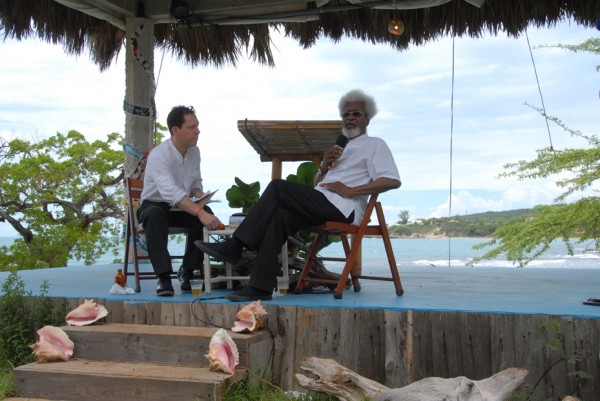
Paul Holdengraber and Wole Soyinka. Photo by Hugh Wright.
LU: This year you have some interesting names, like Salman Rushdie and someone like Prodigy. How do you decide on the programming?
JH: We have very firm brand guardrails. Everything needs to be earthy, inspirational, daring and diverse. Everything we do, we say does it meet this criteria. Then we choose a theme, and we’re very conscious of being an international festival. It’s not a Jamaican festival, it’s not a poetry festival, it’s all genres, all different nationalities. This year we wanted to make sure we had writers from all over the world. Which we have achieved, we have Ngugi Wa Thiong’O from Kenya, Valzhyna Mort from Belarus, Paul Muldoon and Colum McCann, who are Irish, Rahul Bhattacharya from India. As well as Rushdie. It’s an exciting program this year.
KD: Calabash is programmed in a simple, basic way. I [am] looking out for interesting writers who are emerging, new books that are being published. We usually have a long list of writers on our wish list, in fact some of the writers we have this year have been on our wish list for years, and we think about how to find connections to them, other writers who know them. [The] program has to have a number of key elements. It has to have some major marquee name we think will win the attention and interest of our audience. We want writers who have had a book in print within the last two years. if the writer doesn’t, they don’t get invited to the festival. Thirdly we try to make it diverse. It’s an international festival, but it’s also a festival based in the Caribbean, so we like to get some voices from the region. But we also want to make it international in the most broad way possible.
JH: [With] Rushdie, we have mutual friends. He’s known about the festival for a long time and wanted to come, but it was a matter of fitting into his busy schedule. We finally found a year that he could be here.
LU: Does that mutual friend with Salman Rushdie happen to be Jimmy Cliff? Salman and Jimmy are friends. We have this great photo of them together at Miss Lily’s.
JH: [Laughs] No, it was the Jamaican novelist Marlon James. That’s great, though.
What are you doing to bring attention to the literary scene in Jamaica and the broader Caribbean?
JH: Not only does Calabash happen in Jamaica, it happens on the South Coast of Jamaica in a little fishing village that’s one of the most beautiful places in Jamaica, so it can’t help but be Jamaican. We have incredible Jamaican food for three days, reggae every day, it is infused with Jamaica. If we didn’t have one Jamaican writer on the program it would still be completely Jamaican. We have Jamiacan and Caribbean authors on the program not because they are Jamaican or Caribbean, but because they are worthy. We get a lot of requests like “I’m Jamaican and I wrote that book.” Well, that’s great and we applaud you for that but that doesn’t necessarily assure you a place on the Calabash stage.
LU: Is there more attention being paid to Caribbean authors right now?
JH: We have a lot of fantastic Caribbean authors who are doing really well. Two interesting things are happening. One is a lot of authors who identify themselves as Caribbean live outside of the Caribbean, and the other thing is that the writers writing in the Caribbean are not necessarily writing what would be thought of as Caribbean themes anymore. There is a Jamaican writer at Calabash this year, Roland Watson Grant, and his book is set in Louisiana. There is another Jamaican who currently lives in Japan, and his book just won a Commonwealth Writers Prize.
LU: And how does Calabash factor into this?
KD: I think one of the great contributions of Calabash to Jamaica and the Caribbean in general has been to put literature at the forefront in the media, in newspapers, television and so forth. We started a system of book launches that started with Calabash, and book launches are ubiquitous in Jamaica now. We had Novelty Trading, which was then a fledgling distributor, as our key bookseller at the festival and they’ve grown to be the biggest book distributor in the country. We’ve held workshops for writers in fiction and poetry for over 10 years, several of our writers have become quite famous and won major awards. Most importantly, to get 2 to 3,000 people to a festival in St. Elizabeth every year, and these are largely Jamaicans, coming from all walks of life, to just enjoy literature, and have Jamaica be known for its literary festival—those things give a kind of credibility to the literary arts [here]. When a writer from Jamaica gets to read with Junot Diaz, that gives them a sense of belonging in the world of literature. So that is one of our big contributions.
LU: Are there any new authors you are hoping people will discover at Calabash, Jamaican or otherwise?
KD: Some writers who people may not have heard from the Caribbean would be people like Millicent Graham, a poet who will be reading; Karen Lord, who is a relatively established writer and novelist but a lot of Jamaicans may not have heard of her. Roland Watson-Grant is probably the big find but I wouldn’t say we discovered him. He has published one novel and has another coming out. He’s a very exciting young Jamaican writer and I think he’s going to go places.
JH: Roland Watson-Grant is a fantastic talent. Another Jamaican/Nigerian, A-dZiko Simba Gegele, her young adult book just won a prize and she came out of the Calabash writers workshop. Saturday morning we have four Jamaican poets who are reading, and the newly installed poet laureate of Jamaica, Mervyn Morris. We have not had a poet laureate in Jamaica for over 50 years. He was just appointed a week ago and his first reading is going to be at Calabash.
LU: Anything you’re doing differently this year?
KD: One thing we do every year is a celebration of a great, historical reggae album. This year we’re doing Judy Mowatt’s Black Woman, she’s the first woman we are celebrating in that way. It is usually the climactic moment of the festival, where everybody gets up and dances. It’s a feelgood moment. And Judy Mowatt [is] actually coming to sing a couple of songs [with] Wayne Armond, Ibo Cooper, Steve Golding and the rest of the Calabash Acoustic Ensemble. She’s been very enthusiastic about this effort. And listen man, Black Woman is historical. It’s a great album. For a woman producing that album at a time when so few women were in reggae, it’s important. Artists like Etana and Jah 9 can take their hats off to Judy and the work she’s done as a pioneer.
JH: [On Friday] We have BeLo and Jah9, two singer songwriters, a man and a woman, a Haitian and a Jamaican, with very different styles but I think they’re going to be fantastic together. On Saturday night we have Prodigy for the beach party. Prodigy is an interesting story. Here is a hip-hop artist turned author turned publisher. We thought that was a fascinating journey. He is going to read his work on Friday night and perform on Saturday night.
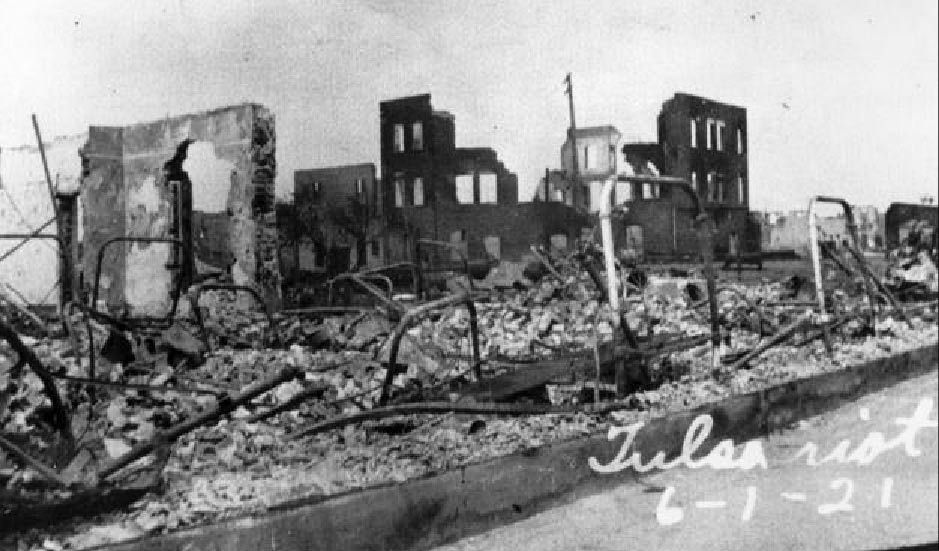
On this day in 1921, the Greenwood District of Tulsa, Oklahoma, often called Black Wall Street, was destroyed. Hundreds of Tulsa’s white residents descended on the prosperous community following allegations that a black man, shoe shiner Dick Rowland, sexually assaulted Sarah Page, a white elevator operator. What actually happened in the elevator remains unconfirmed. By some reports, Rowland stepped on Page’s shoe causing her to scream out, and by others he grabbed her arm. Reports of the attack spread swiftly, and the following day, the Tulsa Tribune printed an article titled “To Lynch Negro Tonight” Rowland was apprehended. A white mob showed up to the Tulsa Courthouse, but was prevented from lynching Rowland by the police and a group of armed Black men. A shot was fired.
Frustrated, the white citizens turned their violence on the wealthy Black community. Tulsa’s police force allowed and encouraged the violence that ended in estimated 300 dead and thousands injured.
Black Wallstreet was the wealthiest Black community in the United States. Whites demolished 35 city blocks of land including 1200 houses, 600 businesses, 30 grocery stores, 21 churches andrestaurants, 2 movie theaters, a hospital, bank, post office, and libraries.
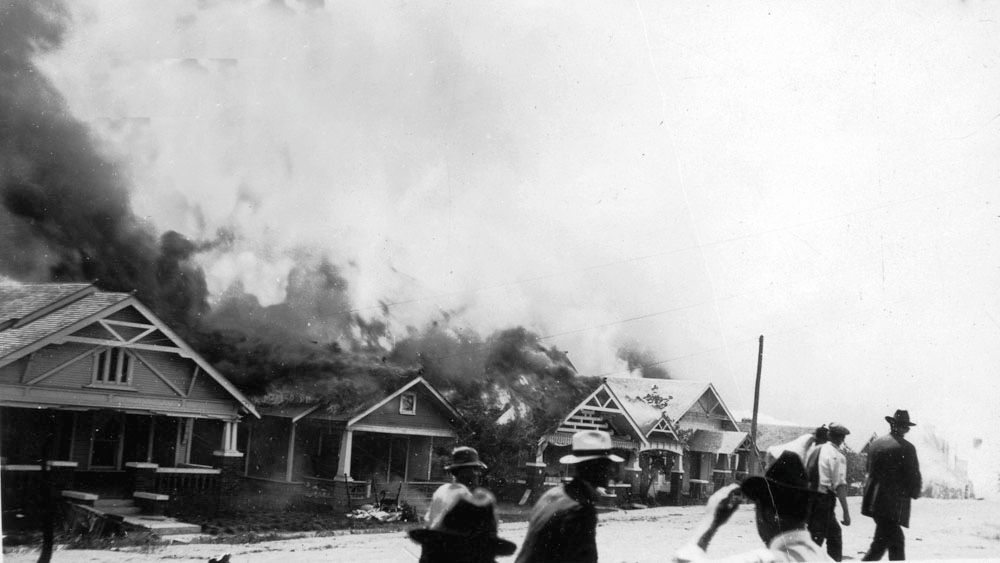
In these events we saw the early use of militarized force on American citizens. Military planes dropped firebombs on the district’s structures.
Greenwood homes on fire
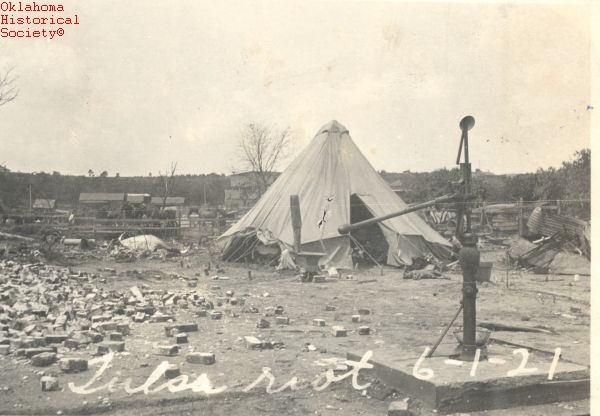
8-10,000 Black residents were left homeless and destitute following the attacks. They lived in tents around the city through the winter of 1921 where they were monitored by police (the same police that encouraged the attacks) and members of the National Guard.
Tent home
Dick Rowland was exonerated, but an all-white jury found Black Tulsans responsible for the attack
This was a clear example of White American terrorism. This tragedy is often billed as the worst single incident of racially motivated violence in American history. Many of those killed in the attacks were buried without proper record.
Not until 2012 was the “race riot” included in Tulsa school curriculum and no reparations have been paid to those who lost their homes and businesses. The exclusion of these events from history texts only reminds us of how diligent we must be in telling and retelling the stories.
Question. mixtape. A blend of the queen’s best including original breaks & unreleased remixes. stream. download. enjoy.
Booty Lucky Fellow No Love Arrow Through Me Fall In Love Love of My Life Kono Samurai Healer RMX Solution Soldier Intimate Friends Fall In Love Love Back In The Day Honey RMX Dream Flower Didn’t Cha Know
Click this button to enter Mind Magazine’s first annual Insight Poetry Competition, $10 per entry, from one to three poems––see contest rules for prizes and entry details:
Mind Magazine’s First Annual Insight Poetry Competition is now accepting entries. Poems must be submitted electronically, or by mail in #12 Times or Times New Roman font, in stanzas, single spaced. Each individual poem should not exceed three pages in length. Entries received after August 15th 2014 will be disqualified. Winners will be announced in the month of September, in the year of 2014. The winners will receive prize money as indicated below, and publication on the “Mind Magazine Top Talent” page, created to showcase the work of the finalists. Poetry entries should contain text only. Illustrative work will be disregarded. All rights remain those of the author, and, no poem may be entered to which the rights to that work are not fully and entirely those of the author.
Prizes:
First place: $300.00, Gold Medal Standing on-line presentation, and publication as specified.
Second place: $150.00, Silver Medal Standing on-line presentation and publication as specified.
Honorable mention:
Third place: $50.00, Bronze Medal Standing on-line presentation and publication as specified.
Forth place: $50.00, Mind Magazine T-Shirt and publication as specified.
Fifth place: $50.00 and publication as specified.
The judges:
Michael Spring, award winning poet and poetry editor for Mind Magazine, and Rich Norman, Mind Magazine’s Editor in Chief, will judge all entries.
Electronic submissions are preferred, and can be purchased in the Mind Magazine store. Please be sure to include the entry identification number provided with your entry purchase, your return email, and the author’s name with each poem entered.
Send all entries clearly marked with the email heading, “Contest Entry” to: mindmagazinesubmissions@gmail.com Up to three poems may be submitted per $10 entry.
Entries may be mailed to:
Mind Magazine
PO Box 387
O’Brien, OR. 97534
Checks must be made out to Mind Magazine.
Entry Fees:
One to three poems: $10 All entry fees are non-refundable.
Submissions:
Mind Magazine is accepting submissions of poetry, prose, scientific articles and scientific papers. Poetry should be no more than three pages in length per poem, single spaced, #12 Times or Times New Roman font, two poems maximum per submission, one submission per month. Send submissions of poetry in electronic form, rtf or Word format, with the email heading clearly marked, “Poetry Submission” to Michael Spring at: bluecrow_4@yahoo.com Include your return email and contact information.
Submissions of prose, scientific articles and papers must be provided single spaced, #12 Times or Times New Roman font, one submission per month, in electronic form, rtf or Word format, with the email heading clearly marked, “Prose/Science submission” to Rich Norman at: mindmagazinesubmissions@gmail.com Include your return email and contact information.





 .
.