
July 7, 2016
‘We just need to
stick together,’ says
Yemeni-born
shopkeeper who
filmed shooting of
Alton Sterling
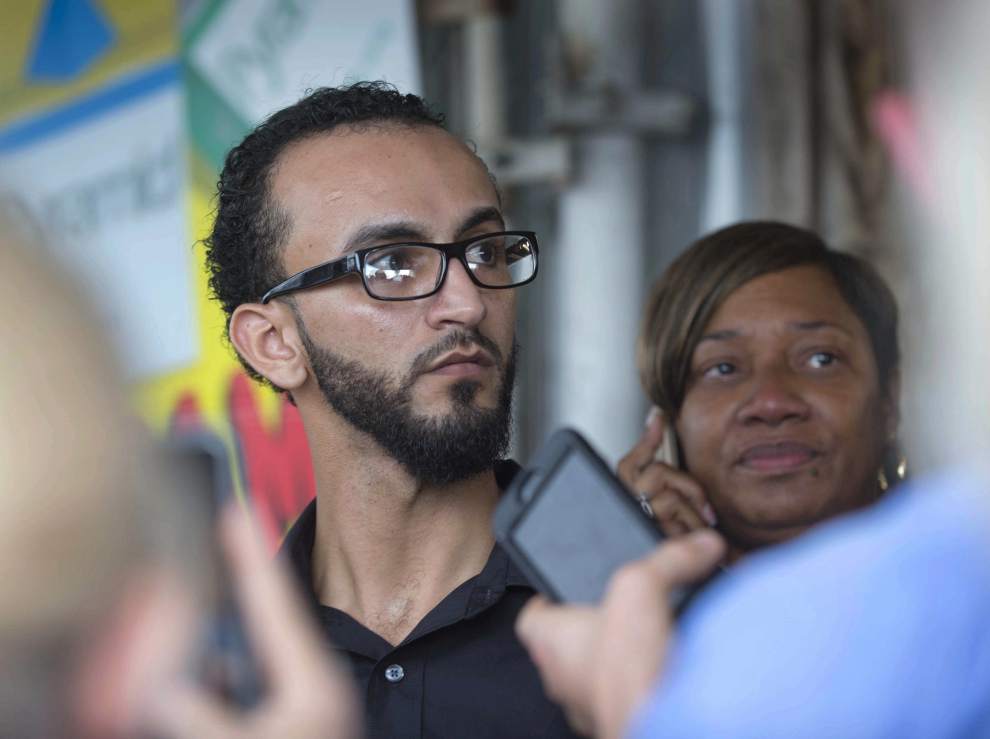
State Rep. C. Denise Marcelle, right, D-Baton Rouge, stands outside Triple S Food Mart with Abdullah Muflahi, the owner and manager of the store in Baton Rouge, La., Wednesday, July 6, 2016. Alton Sterling was shot and killed during a scuffle with police officers outside the store Tuesday, Muflahi said Sterling was not holding a gun during the shooting but that he saw officers remove one from his pocket afterward. (Travis Sprawling/The Advocate via AP)ORG XMIT: LABAT203
BY RAMON ANTONIO VARGAS
| RVARGAS@THEADVOCATE.COM
Two days after he stepped outside of his Baton Rouge convenience store to record video of police fatally shooting Alton Sterling, Abdullah Muflahi was cornered in the back of his business by the fallen man’s aunt.
Sandra Sterling’s message to the thin, bespectacled man who helped sear her nephew’s name and fate into the national conscience was simple: “You’re going to speak at the funeral. Yeah, you’re going to be on the program. You know that.”
The exchange was brief, but it was typical of the respect those affected by Sterling’s death have shown Muflahi, who turned over his cellphone video of the shooting to federal investigators as well as reporters asking questions about whether the use of force by police was justified.
Muflahi, 28, who was born in Yemen, may seem an unlikely ally of those who hope to see charges filed against the two white police officers who tussled with Sterling — an African-American — before one of them shot him in the chest early Tuesday.
But Muflahi, who spent most of his youth in Michigan before opening the Triple S Food Mart at 2112 N. Foster Drive in Baton Rouge almost six years ago, said those who understand how he was brought up would easily understand.
Though he and his family are from Yemen, they were in Detroit for many of Muflahi’s childhood years. The demographics of Muflahi’s largely African-American neighborhood there left him with little choice but to grow comfortable with — and respectful of — people who were neither Yemeni nor Muslim like him and his relatives, he said.
“There were maybe three others who were Arab or Muslim,” said Muflahi, who didn’t know English when he moved to Michigan but now speaks the language with a virtually perfect American accent. “So my parents told me to get along with everybody — don’t judge on color, race or religion.”
When Muflahi was in middle school, he learned that not everyone in his adopted country had been brought up with the same values. Some time after the 9/11 terror attacks, the windows at Muflahi’s house were shattered, and someone unsuccessfully tried to break into the home, Muflahi recalled.
Muflahi said his parents reported the incident to the police. Officers never figured out who did it, so Muflahi’s family moved to the nearby community of Dearborn, home to one of the country’s biggest Arab-American and Muslim populations.
The switch suited Muflahi until he finished high school. But he yearned to move away to a place that was maybe a little more like where he had spent much of his childhood.
He settled in late 2009 on Baton Rouge, where a close friend worked, and signed up to take classes at Baton Rouge Community College.
The neighborhood around BRCC popped up after World War II on what was then the outskirts of the capital city, offering landowners spacious lots and plenty of shade from oak and pecan trees, just five miles from downtown.
As the city has sprawled around the neighborhood over the decades, the big yards and tree cover remain. However, in and around the neighborhood’s western edge, North Foster Drive, a handful of yards are littered with telltale signs of a community in distress: cans in brown paper bags; shells of cars, missing tires, doors and engine covers; and mattresses with large tears.
Some lots are overrun by grass and weeds several feet high. The paint on some ranch homes is faded, and some houses have balky roofs or missing shingles.
Muflahi, though, said the people he has met since his arrival have accepted him as he was, despite their various surface differences. So, when the chance to buy the Triple S on North Foster and move in by August 2010 presented itself, he didn’t think twice about it.
Evidence of unrest over Sterling’s death was everywhere midday Thursday outside the store.
In the parking lot, a few feet away from a spray-painted sign that read “F*** BRPD” and “Fly High Alton,” a man in a T-shirt decorated with Black Power imagery had a rifle with a long-range scope slung over his shoulder and a pistol holstered on his hip, as other protesters and members of the media from all over the country came and went.
Intermingled with such extraordinary scenes were more mundane interactions that hinted at the rapport Muflahi had developed with his customers in more normal times at the store.
Dressed in a white dress shirt and dark business slacks, Muflahi was unbothered by the sight of a group of men who were loitering a few feet away from his entrance, drinking and chatting loudly. He exchanged waves with one man, flashing a smile at him and quipping: “Excuse me. If you don’t quiet down, I’m going to have to ask you to leave.”
Others who went inside shook his hand, embraced him and asked how he and his family were doing.
Only after that did those customers — addressed as “sir” or “brother” — walk down one of the store’s six aisles; pick out anything from cold drinks and cigarettes to brightly colored bandannas and fried chicken; and take it to the register.
Regular customer Tanisha Johnson said that in her experience, not every business owner is patient with his local clientele. But Muflahi was, evidenced by his willingness to allow Sterling and at least one other man to try to earn a few bucks selling CDs outside his convenience store, asking for nothing in return.
Tuesday morning was something else entirely, Johnson said, showing Muflahi cared enough about a regular to secure and distribute a recording that could be instrumental in helping authorities determine whether or not officers Blane Salamoni and Howie Lake II are criminally liable in Sterling’s death.
“It makes you feel safe, that he cares, because some people don’t,” said Johnson, who was helping Muflahi at the store on Thursday.
Muflahi said he never imagined himself acting differently.
“They’ve allowed me to become a part of this community, … and I wanted to stand for Alton,” Muflahi said. “We just need to stick together — no matter what race we are, no matter where we are from.”
____________________
GRAPHIC!!! HERE’S A CLOSE-UP
VIEW OF THE ALTON STERLING
SHOOTING, WITH MUCH
CLEARER AUDIO…
Please visit us at FlyNubianQueen.com and follow us on Facebook!
____________________

07.11.16
COVER UP?

Alton Sterling
Witness:
Cops Took My Phone,
My Surveillance
Video, Locked Me Up
officer who killed a man selling CDs
immediately ordered him to be detained
and then stole footage of the slaying.
BATON ROUGE, Louisiana — The owner of the convenience store where Alton Sterling was killed last week by cops alleges in a lawsuit that police stole surveillance video from his shop, confiscated his cell phone, and locked him inside a car for the next four hours.
Abdullah Muhlafi, proprietor of the Triple S Mart, saw police confront and kill Sterling who was selling CDs with his permission in the front parking lot last Tuesday night. Muhlafi recorded part of the incident in footage he gave The Daily Beast last week that shows Sterling did not have a weapon in his hand when Officer Howie Lake shouted “gun!” and Officer Blane Salamoni fired six shots into his chest.
Muflahi claims in a lawsuit filed Monday in Baton Rouge district court that after Salamoni killed Sterling, he immediately told responding officers Lt. Robert Cook and Officer Timothy Ballard to confiscate the “entire store security system” and detain him.
“I told them I would like to be in the store when [they took it],” Muflahi told The Daily Beast, adding that he also demanded they get a warrant for the seizure of his private property.
Officers didn’t even file an application for a search warrant, The Daily Beast found last week. Nor did Muflahi sign a “Voluntary Consent to Search Form” with the Baton Rouge police.
After taking away Muhlafi’s cellphone — and the damning video on it — Lt. Robert Cook and Officer Timothy Ballard locked the him in the back of a police car for the next four hours, the lawsuit claims. The only time Muhlafi was let out was when he had to use the restroom.
“The officers would not allow Mr. Muflahi to use the restroom inside of his business establishment and he was escorted to the side of his building and forced to relieve himself right there within arm distance of a BPRD officer and in full view of the public,” the lawsuit states.
During the four hours inside a cop car and another two hours at police headquarters, Muhlafi was allegedly prevented from making a phone call to his family or an attorney.
Muhlafi is suing Salamoni, Lake, Cook, and Ballard as well as the City of Baton Rouge and police chief Carl Dabadi. The lawsuit seeks damages for “false arrest, false imprisonment, the illegal taking and seizing of his security system, illegally commandeering his business,” attorney Joel Porter told The Daily Beast on Monday.
Hours after Muflahi’s lawsuit was filed, it was revealed that police had filed the search warrant and the affidavit with a court clerk on Monday morning–six days after Sterling was killed.
The warrant suggests that Cook waited five hours after he began his investigation at the Triple S Mart before applying for a warrant to search for the video. Cook submitted an affidavit to Commissioner Quintillis Lawrence at 5:23 a.m. and Lawrence authorized the warrant that very same minute, court papers show. At 5:50 a.m. Cook began his search and finished by 7 a.m., according to the warrant’s return.
“The timeline definitely doesn’t add up,” Porter told The Daily Beast.
Muflahi claimed in his lawsuit that police detained him and took the hard drive around 1 a.m. So either police waited five hours to get a warrant and seize the hard drive or they grabbed the hard drive and got a warrant after the fact to make the seizure appear legal.
The only way to know which scenario is true is to see the security camera footage, which would show if it was terminated before or after the warrant was authorized. However, police don’t have just the video but the hard drive itself, making it impossible to challenge their timeline of events unless and until they give up the video.
And Sterling’s family wants it released.
Porter claims police exceeded the warrant’s authority by seizing the hard drive.
“The warrant gives the Baton Rouge Police Department the authority to search the surveillance video on recording device, it doesn’t give them the authority to seize the device,” he said.
The warrant states that “the purpose and reason for the search is to find and seize the item(s) listed above,” referring to “Video Surveillance from the Digital Video Recorder.” It continues, “You are hearby ordered to search the aforesaid Revo Digital Video Recorder …and if the thing(s) specified are found there, to seize them and hold them in safe custody pending further orders from the court.”
How did the police know the brand of recorder without already searching the back room where it was kept? Porter asked.
“They lied in the warrant,” he said, calling it “laughable.”
In response to questions surrounding the investigation, Gov. John Bel Edwards “believes all evidence should be collected in accordance with the law,” said spokesman Richard Carbo, although he wouldn’t comment on the specifics of the case, and again deferred to law enforcement on details.
Louisiana Congressman Cedric Richmond told The Daily Beast, “I think the public has a right to know under what authority the tapes were seized.”
Protests over Sterling’s killing have been escalating over the past few days, with 48 people arrested on Sunday and more than 100 arrested on Saturday. More protests are planned for Monday with no signs of letting up.
Editor’s Note, 7/11/16, 6:45 p.m.: This story was updated throughout after police revealed they had a search warrant.