
SEPTEMBER 12, 2013

Maki Oh: Flygeria
Investigating the essence of Nigerian swagger, and why Maki Oh is the Lagos designer you need to know

Maki’s sketchbooks, filled with drawings for her next collection.
Mobolaji Dawodu: Maki Oh is a fly womenswear line from Lagos, the largest city in Nigeria. There are a lot of people making really beautiful clothes out of Lagos right now, but Maki is the one who really gets me thinking about Nigerian style, that unique Nigerian swagger. My dad’s Nigerian and my mom’s American. My parents moved to Nigeria in the ’70s, and when they wanted to have me, they came back to the States, and then I went back to Nigeria when I was five weeks old! I stayed until I was 10. But I would say you can’t think about Nigeria without style—Lagos in particular, which is where I grew up. It’s a mega-city. The way Nigerian culture is, it’s very proud. The way people talk, the way people dress, the way people bargain for what they want, the way people charm—it’s all very stylish. It’s the hustle, it’s the charm—everything in Nigeria is an art form. There is no separation between art and life. Life is art.

Maki working with fabric in her Lagos apartment. For many fabrics, she uses a dye process known as adire, traditional to the Yoruba ethnic group. This ancient process, which is gradually fading away from villages across Yorubaland, is one of the ways that Maki combines the new and the old in her work.
Walking down the street in Lagos, there are a lot of African prints, a lot of woven fabrics, long skirts, head-ties. It’s everything from Western attire to traditional attire. That’s the amazing thing: there’s no set rules about who’s going to wear traditional clothes. It doesn’t mean you’re rich, it doesn’t mean you’re poor; everyone wears everything. There are so many influences from so many walks of life. Maki draws from the traditional stuff, because that’s where it started, but she’s mixing it up. Her clothes are beautiful and elegant and could be from anywhere, just like a lot of ensembles you see when you’re walking around in Lagos today. 
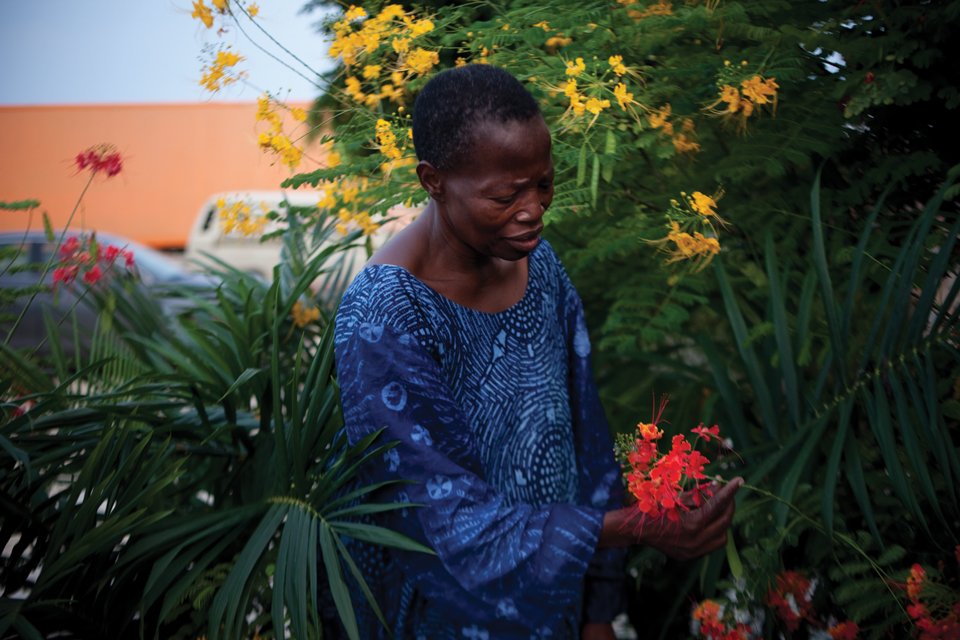
Nike Okundaye—or Mama Nike, as she is known—is a major custodian of the Yoruba arts, including the adire dye process. As a mentor to Maki, she lets the designer consult the museum of rare African textiles at Nike Art, the gallery she owns.
Maki’s work stands out because she uses fabrics in Africa that aren’t the norm. Nowadays, everybody is doing a lot of beautiful designs with African prints, or ankara—like the Turkish capital. But the fabrics that Maki uses are more obscure. When you see an African print, you look at it and you’re like, Oh that’s an African print, but what she uses, when you look at it, it’s not just about Africa. It’s a mesh of many influences. A lot of ankara fabrics are actually imported from Holland these days; the prints that Maki uses will be hand-painted and stitched in Nigeria, but they’ll be a play on those traditional designs and the stories they tell, like a dress that’s covered in eyes, or fish, or a very contemporary-looking abstract design. That’s what people find interesting about her. You can’t place it so fast and so quickly. When I think about Nigeria and style, when I think about women and Nigeria, I think about femininity. African woman are very feminine, and the femininity of Maki’s clothing—as much as it’s different from a lot of things you see in her country—is what connects it very much for me to Nigeria. Femininity is about an attitude and a way you carry yourself. Nigerian women don’t reveal as much as people reveal in the West. It’s a lot more covered up and just sexy; it’s traditional clothing and traditional fabrics and long skirts—like mermaid skirts.

This top and skirt look was handpainted and hand dyed with indigo with the adire technique. The print on the skirt is a traditional Yoruba motif called gangan, which translates to “talking drum,” a Yoruba instrument made from goat’s hide and played as a means to pass messages from village to village.
Maki thinks a lot about the female form; she plays with the contrast between covering and revealing. One of her first pieces that got a lot of attention was a hand-sewn, calabash mosaic long-sleeved top that reproduced the shaded contours of the nude female chest in graphic form. More often, it’s about combining opaque fabrics with more sheer materials, about highlighting the shape of the body without directly showing much skin, or showing little glimpses of it in unexpected places. She definitely has contemporaries from Nigeria doing beautiful clothes, a lot of wonderful things, but I think she’s toned it down a bit. I think that’s why we gravitate toward her: it’s not so out-there, it’s not so bold, it’s not so obvious. It’s a little more subtle and understated. There’s just something effortless about her style, the way her clothes flow, just in the shapes. She has one of those lines where the person wearing the clothes makes the clothes. There’s a lot of room to be that woman, so to speak, the Maki Oh woman.
>via: http://www.thefader.com/2013/09/12/maki-oh-flygeria/#/0