26th Dec 2013

THE BLACK POWER SALUTE
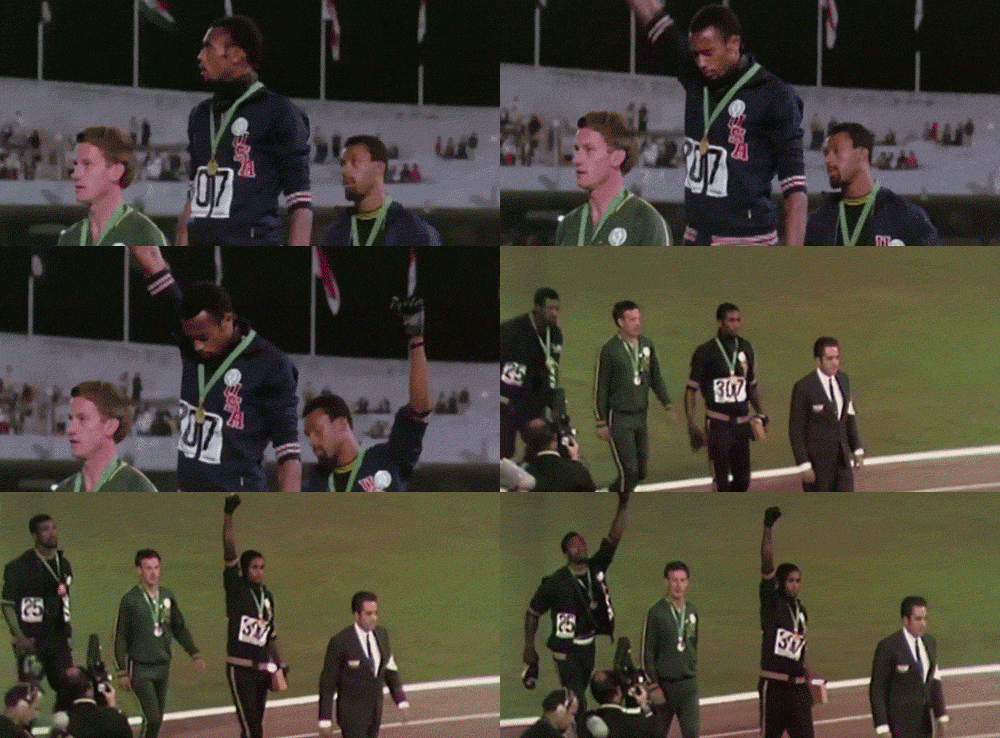
I’ve never seen a GIF of this.
I was just reading about this during a wiki binge on Olympics incidents and did a little research on it. I never knew how deep the message was that Smith and Carlos were trying to send. Just about everything they wore and how they wore it had symbolism attached to it. (unzipped tracksuits for solidarity with blue collar workers, necklace of beads for lynching victims, etc) Calling it a “black power salute” is really reductive and it’s a shame (and predictable) that if it’s taught at all, that’s what it’s boiled down to.
Another thing I didn’t know: the Australian guy who came in second wore a patch for solidarity with them, he was protesting racist Australian immigration policies. When he passed away, Smith and Carlos were pallbearers at his funeral.
Don’t know what this is referring to?Here you go.
This is really powerful.
Wow, I had no idea about the solidarity patch.
This is still so powerful to watch.
(fyi Australian guy’s name is Peter Norman, he was banned from competing internationally for Australia after this, because our government can be a real sack of dicks sometimes)
I had no idea there was so much going on here. It’s fascinating. According to the Wiki article:
The two U.S. athletes received their medals shoeless, but wearing black socks, to represent black poverty. Smith wore a black scarf around his neck to represent black pride, Carlos had his tracksuit top unzipped to show solidarity with all blue collar workers in the U.S. and wore a necklace of beads which he described “were for those individuals that were lynched, or killed and that no-one said a prayer for, that were hung and tarred. It was for those thrown off the side of the boats in the middle passage.” All three athletes wore Olympic Project for Human Rights (OPHR) badges after Norman, a critic of Australia’s White Australia Policy, expressed empathy with their ideals. Sociologist Harry Edwards, the founder of the OPHR, had urged black athletes to boycott the games; reportedly, the actions of Smith and Carlos on 16 October 1968 were inspired by Edwards’ arguments. Both U.S. athletes intended on bringing black gloves to the event, but Carlos forgot his…It was…Peter Norman, who suggested Carlos wear Smith’s left-handed glove, this being the reason behind him raising his left hand…differing from the traditional Black Power salute. When “The Star-Spangled Banner” played, Smith and Carlos delivered the salute with heads bowed, a gesture which became front page news around the world. As they left the podium they were booed by the crowd. Smith later said “If I win, I am American, not a black American. But if I did something bad, then they would say I am a Negro. We are black and we are proud of being black. Black America will understand what we did tonight.
(Source: bloggingisnotwriting)
__________________________
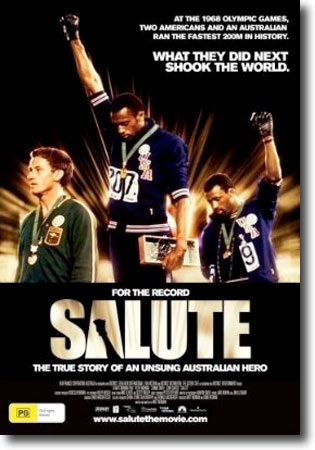
Paying homage to the definitive black power homage
As far as historical milestones go, there is certainly an insignificant amount more rousing than the one concerning the symbolic, brave hand gesture that spawned a counterculture for the black civil rights movement. How ironic then, that this legitimately falls at the first hurdle, Norman’s handiwork never accumulating the sought inspirational highs, and more worried of the account of Peter Norman, the Aussie runner, ends up being somewhat of a watered-down tribute.
Director Matt Norman (who is actually Peter’s cousin), doesn’t get it all disastrously wrong. Focusing on the fallout post-Olympics, we are introduced to the political ugliness of Jim Crow-era 1968, (keeping in mind this is the year Martin Luther King and President Kennedy were assassinated for openly supporting the civil rights movement) and it’s hard not to be swept up in Christopher Kirby’s solemn narration. Furthermore, the plethora of primary interviews and archive footage – chiefly surrounding the holy trinity of ensemble sports personalities – add a lot of meaningful gravitas, there’s brilliant little scenes where the trio give their recollections as old men looking back.
Norman does spend a great duration of the doc labouring over the tedious details prior to the occasion, and those smartly conjecturing the futility of bringing to light the plight of one single occasion will be proven correct. Love-it-or-loathe it, the cynical, rather obtuse stances presented give audiences a chance to gauge the different attitudes of the time, but this still can’t prevent it being a tame retelling that leaves too much unsaid. Erroneously concentrating on the modest Norman (who’s consent led to his national shunning), this could have gained from revealing more of the curious stories of the other runners, Smith and Carlos.
Buffeted by placid story telling and hazy execution, Salute is as fascinating as it is friendly, so tragically flawed that it’s never worthy enough to weigh up to the momentous incident, let alone its fleet-footed talent. Unless you paid ill attention in history class, this will all prove a little too… familiar.
★★★
