
Talking jazz with Kato Change,
one of Kenya’s
premiere jazz guitarists

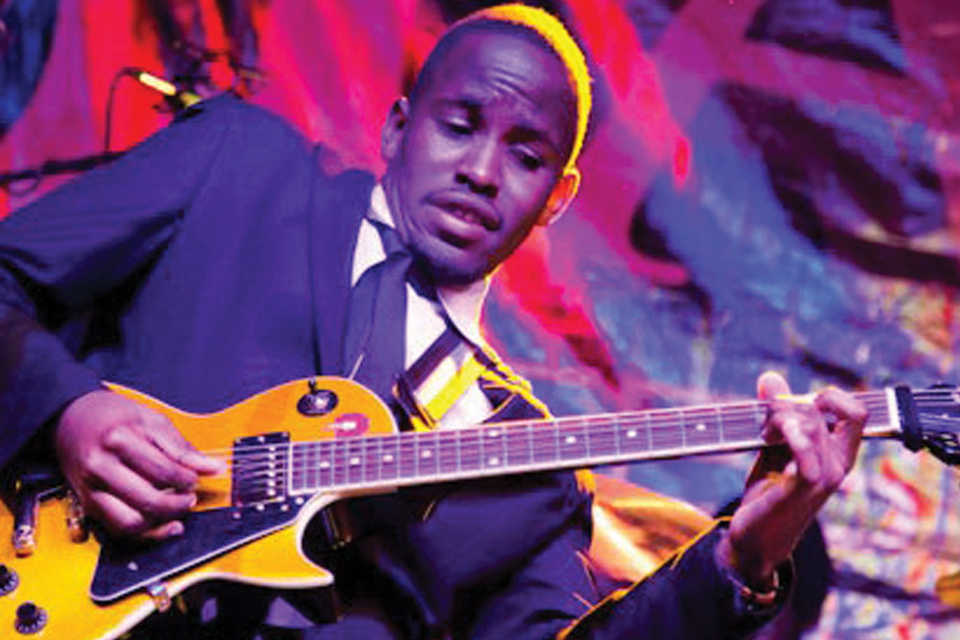
Kato Change (Photo credit: Shadrack Mwamburi)
by Siji Jabbar
The Kenyan contemporary urban music scene has pretty much recovered from the low point in the early nineties when piracy devastated music sales and made it less than worthwhile to record at all, and you now have a new generation of artists working successfully in a range of styles – R&B, pop, reggae, hip hop, gospel, Afro-fusion (indigenous African sounds and instrumentation merged with beats from around the world). We rarely hear about jazz, though.
There are a handful of working jazz musicians in Kenya, but whether or not it’s populated enough to be called a “scene” is another matter. Nonetheless, we remain curious, particularly as we discover more upcoming young talents like Christine Kamauand Kato Change, so we decided it was time to find out a bit more. We ended up chatting with Kato, already one of Kenya’s premiere jazz guitarists, and one well on his way to developing a truly distinctive sound.
TIA: You’re a self-taught jazz musician, but Kenya isn’t particularly well known for jazz, so how and when did you discover jazz and develop such great chops?
Kato Change: My dad was an avid jazz listener and fan, so I grew up listening to jazz, along with rock, hip hop, neo soul, R&B, new jack swing and classical music, but I didn’t fully appreciate jazz until I was in my mid teens. That’s when I picked up the guitar and started learning to play jazz. It simply fascinated me.
TIA: The guitar; we hear it’s the most dominant instrument in Kenyan popular music. Why is that?
Kato Change: In a lot of Kenyan styles, the guitar is indeed the dominant instrument. I think that Kenyan popular music is influenced a lot by Congolese music, like the Seben [the break in a song that allows musicians to cut loose instrumentally] which is driven mainly by the guitar. However, this type of music is appreciated more by the older generation. The younger generation’s music is influenced a lot by the Western culture/music, such as hip-hop, where the drum and bass are featured more.
TIA: You just opened the Sierra Jazz Festival, where you played alongside Christine Kamau and Incognito. What was that like?
Kato Change: It was a brilliant show! My band and I had a blast on stage. Christine Kamau held her own and had a very tight set of beautiful original pieces. Incognito is a brilliant band, one of the first jazz bands I listened to on a “Jazz Moods” album. Their hard work, experience and brilliance over the thirty-something years they have played together showed in their performance.
TIA: You were also recently on a month-long tour of the States and got to perform with jazz, hip hop and pop greats like multi-award-winning trumpeter and composer Dave Douglas and Greg August, A Tribe Called Quest’s Ali Shaheed and producer Joel Hamilton (Blakroc, Elvis Costello, Tom Waits, Justin Timberlake, Sparklehorse). How did that come about and what was it like playing with these musicians?
Kato Change: I feel extremely blessed to have been selected to be part of a musical program called One Beat. It is a new international cultural exchange by the U.S. Department of State and Found Sound Nation that celebrates the transformative power of the arts through the creation of original, inventive music, and people-to-people diplomacy. I had the chance to meet with 32 exceptional young musicians from around the world, and we spent time writing, producing and performing new music. Together, we held engagement events with local youth, collaborated with master-class musicians and developed strategies for using music to make a positive impact on our local and global communities.
TIA: Man, that sounds like a valuable experience. So what was the difference playing with the jazz artists versus, say, Ali Shaheed?
Kato Change: When playing with jazz artists, I felt there was more room for improvisation. The musicians could blend, exchange and feed off each other’s energy. Hip-hop was more of a set 3-part, tight groove, that provided more of an opportunity to please an audience and showcase individual skills. I think
TIA: That makes sense. And what’s the difference between playing for American jazz fans versus Kenyan fans?
Kato Change: I think the appreciation for any type of music comes with exposure. American audiences have a deeper appreciation and understanding for jazz, making them more receptive. For example, in an ensemble performance, the crowd in the States would clap after every solo. But at home, the reception is different in most cases. I feel many events featuring jazz performances [in Kenya] seem to be viewed more as socializing platforms.
New single “Sta.ka.to” featuring Lisa Oduor-Noah (whose voice you’d have heard on “Room for Me“, one of the tracks on “BLNRB: Welcome to the Madhouse“) and Jaaz Odongo. Video shot by Magiq Lens Kenya.
TIA: What you play on “Sta.ka.to” sounds almost Malian (love the video, by the way). Other times one detects some Latin elements in your music. What other styles of music inspire you, and do you draw on any particular Kenyan or East African styles when you play?
Kato Change: Thank you! That song draws on the sound of an instrument called the Nyatiti, from Western Kenya. I also love the sound and rhythms of the West African Kora. I try to incorporate elements of these diverse styles into my music.
TIA: Ah, the Kora! Fabulous sounding instrument. That’s why I detected a bit of Mali in there. How much of what you play is improvised and how much is composed?
Kato Change: It depends on the ensemble I’m playing with. For example, in The Change Quartet, we have a structure for the songs we compose. However, when we get on stage, we allow ourselves to be creative; anything can happen. [Kato Change is a member of The Change Quartet, an instrumental band that fuses acoustic jazz with classical music, funk and African music.]
TIA: You know better than me how many sub-genres exist within jazz, and that they don’t all overlap; there’s smooth jazz, fusion, straight-ahead jazz, modern mainstream jazz, avant-garde jazz, post-bop, vocal jazz, trad jazz, improvisational jazz, semi-improvised jazz, free jazz, modal jazz, etc. Most of the time, though, when African jazz fans talk about jazz, they seem to talk only about smooth jazz, Grover Washington, Kenny G, Earl Klugh, Paul Hardcastle, etc. as opposed to people like Dave Douglas, Lionel Loueke and Keith Jarrett. Why do you think that is?
Kato Change: This can also be attributed to one’s exposure. Few radio stations [in Kenya] play the different types of jazz. Many people form their perceptions from what another may tell them is jazz. In this case, it is often more mainstream and smooth Jazz. So [in the past] this was what many members of the audience expected when they came to performances. But that view is slowly changing because of accessibility to music online. I feel African jazz fans are becoming more open to hearing something new.
TIA: That’s good news, man, cos I imagine a deeply knowledgeable audience can spur artists on to greater heights. Where exactly is the epicentre of jazz in Kenya? And is there such a think as a jazz scene in Kenya, by which I mean enough jazz artists together in one city supporting and inspiring one another, as well as a large enough audience base to fill venues where jazz is played and push jazz musicians to keep developing?
Kato Change: The epicenter of Jazz in Kenya is definitely Nairobi, the capital. I do believe there is a jazz scene in Kenya. There are a handful of jazz musicians here who all know each other. The Kenyan audience is very unpredictable, though. In some cases, you may come across true jazz lovers. In others, people may attend gigs based more on the hype around the gig rather then the quality of music.
TIA: An interesting challenge, no doubt. So which jazz musicians working today do you admire?
Kato Change: In Kenya, Aaron Rimbui and Chris Bitok. Through their dedication, they have both moulded their names into brands. They are consistent with their international standard of good quality performances. Internationally, I admire Herbie [Hancock], Sylvain Luc, Esperanza Spalding, Lionel Loueke, Birelli Lagrene, Robert Glasper, the list goes on and on…
TIA: Some big names! Lionel is amazing. When you’re not touring and writing music, what do you listen to?
Kato Change: My playlist consists of a lot of urban gospel like Kim Burell and Micah Stampley; neo-soul artists including Jill Scott and Chrisette Michelle; alternative/soft rock like Coldplay and Kings of Convenience; African music by Richard Bona and Fela Kuti; and jazz such as Sylvain Luc and Marcus Miller. I also listen to modern house music from Swedish House Mafia and DeadMau5… in short I listen to everything I find positive. It depends on my mood.
TIA: Have you toured Africa yet, or do you plan to anytime soon?
Kato Change: I have not had the opportunity to tour the continent as Kato … yet! I cannot wait to do so! However, I’ve had the chance to play for shows in Zanzibar (TZ), South Africa, Rwanda and Ethiopia, backing other artists. I loved the experience and reception.
TIA: How about recording? Do you have an album in the works?
Kato Change: I do have an album in the works, which I plan on releasing mid-2013. Look out for it!
TIA: We will, man, and thanks for taking the time to talk to us.
Kato Change: It was a pleasure! Thank you for the opportunity.